Should You Buy Off-Plan in Dubai in 2026? What the Data Says
Buy a home that does not exist yet, pay for it while it rises, and trust that the market will still be there when you collect the keys. Put like that, off-plan sounds like a leap of faith. The record of the last cycle tells a calmer story.
We followed 15 Dubai projects whose developers sold heavily in 2022 and which were finished by 2025: in 2026, 13 of them were changing hands for more per square foot than their launch price, some for well over half as much again. So is 2026 still a good year to follow them in?
That still leaves a real decision for anyone buying today, because results ranged widely from one building to the next. This guide sets out what the 2026 market looks like, what off-plan does well, where it asks for care, and a short checklist to decide whether it fits your plans.


Is It Worth Buying Off-Plan Property in Dubai?
For most buyers who can wait for income and choose the developer carefully, it is. Off-plan lets you enter with a small deposit, pay the rest while the building rises, and own a new home that, on recent evidence, has usually been worth more by handover than at launch.
The main arguments in its favour:
- A lighter entry. You commit a fraction of the price at signing and spread the rest over construction, often without a bank.
- Room for growth before handover. The 2022 launches we tracked are mostly worth more today.
- First pick of units. Early buyers choose the floor, view and layout.
- A new home with current standards. Layouts, finishes and building systems designed for today's tenants.
It works less well if you need rental income straight away or cannot keep up the payment schedule; both points are covered below.
The 2026 Off-Plan Market in Dubai: What Buyers Are Doing
Off-plan has become the normal way to buy a home in Dubai: 73.8% of apartment sales from January to September 2026 were off-plan. Prices from launch to handover have mostly moved in the buyer's favour, and new supply arrived at a steadier pace this year.
How off-plan became Dubai's main market
The rise has been steady. In 2019 buyers signed 22,249 off-plan deals; in 2025 they signed 145,202, the most in the series. The share has grown with the volume: in 2019 six in ten apartments were sold off-plan, today it is close to three in four. For an investor, that depth matters at both ends of the deal: more projects to choose from at entry, and a large pool of buyers who already understand the format when you sell.
Over the same nine months of 2026, developers launched 289 new projects with 67,281 units between them. A calmer launch calendar gives the projects already under way more room when they hand over, which supports both rents and resale prices in those buildings.
Off-plan property prices in Dubai: from launch to 2026
Two projects in the same community, District One, moved very differently: the villas rose 89%, the apartments 9%. Two others, both completed, now trade under their launch level. For a buyer, this is good news with a condition attached: the market has rewarded off-plan buyers on balance, and the choice of building decides how much of that reward reaches you. Hills Park and Park Ridge, both in Dubai Hills Estate, show how much the building matters even inside one community; our Dubai Hills Estate investment guide looks at that in detail.
Who buys off-plan in Dubai: deals by budget in 2026
Most off-plan buyers are spending modest sums. Below is what each budget typically bought:
Below $500,000 almost every purchase is an apartment, with Dubai South and JVC at the centre of demand. For where each district sits on price and growth prospects, see the best areas to invest in Dubai in 2026.
Benefits of Buying Off-Plan Property in Dubai
The benefits of buying off-plan property in Dubai come down to three things: a lighter way in, a chance to gain before you move in, and a new home on your terms.
- Pay as it rises. A booking deposit and the DLD fee at signing, the rest in stages linked to construction. Your capital stays with you for longer.
- No bank needed during construction. The developer's plan replaces a mortgage until handover, which suits buyers abroad and those paying from savings.
- Value can build before handover. Developers usually release a project in phases and raise prices as it sells, so early buyers start from the lowest price list.
- The pick of the building. Floor, view, layout and parking are all available at launch.
- Modern standards. New buildings come with current layouts, energy systems and amenities that tenants look for.
- Protection built into the law. Payments go into an escrow account tied to the project, and every registered project's progress can be checked on the Dubai Land Department website.
How a payment plan spreads the cost
Take a $372,000 apartment, the median purchase in the $300,000–500,000 band, on a 10/70/20 plan of the kind Damac District is offering this year. You pay about $52,100 at signing (10% plus the DLD fee), about $260,400 in stages over construction, and about $74,400 at handover. Other current plans shift the weight: Sobha City asks for 10% at booking and 80% during construction, Binghatti Spectre 10% and then 40% before handover and 50% at the keys (DXB Interact, October 2026).
Had that apartment followed the median of the 2022 launches we tracked, it would have been worth around $494,800 by 2026, while most of the price had been paid in instalments along the way. Past results are a guide to how the format has worked, and every project will write its own outcome.
One honest note on price: per square foot, off-plan usually costs more than a finished home nearby, though the gap has narrowed sharply. Our comparison of off-plan vs ready property shows it district by district. The advantages of buying off-plan property in Dubai lie in the entry and the upside, and the price you pay for them is the wait.
"A client from Germany set out to buy a finished home with a Dubai bank mortgage, and the financing stalled. We moved his search to the primary market, where the developer’s payment plan did the work of the loan during construction. For many buyers abroad, that is the most practical way in."
Off-Plan Advantages for Luxury Properties
At the top end, off-plan gives buyers access to the most sought-after addresses before they exist on the resale market. Flagship waterfront and branded projects are usually sold in phases, and the first phases carry the lowest prices of the project.
Deals above $1 million made up 14.2% of off-plan sales in 2026, at a median of about $1.65 million. Apartments in this band sold for a median $890 per square foot, villas for $523. Waterfront villa communities lead this band: Damac Islands 2 and Emaar's The Oasis recorded the most deals above $1 million.
Luxury off-plan property in Dubai: where $1 million-plus deals happened in 2026
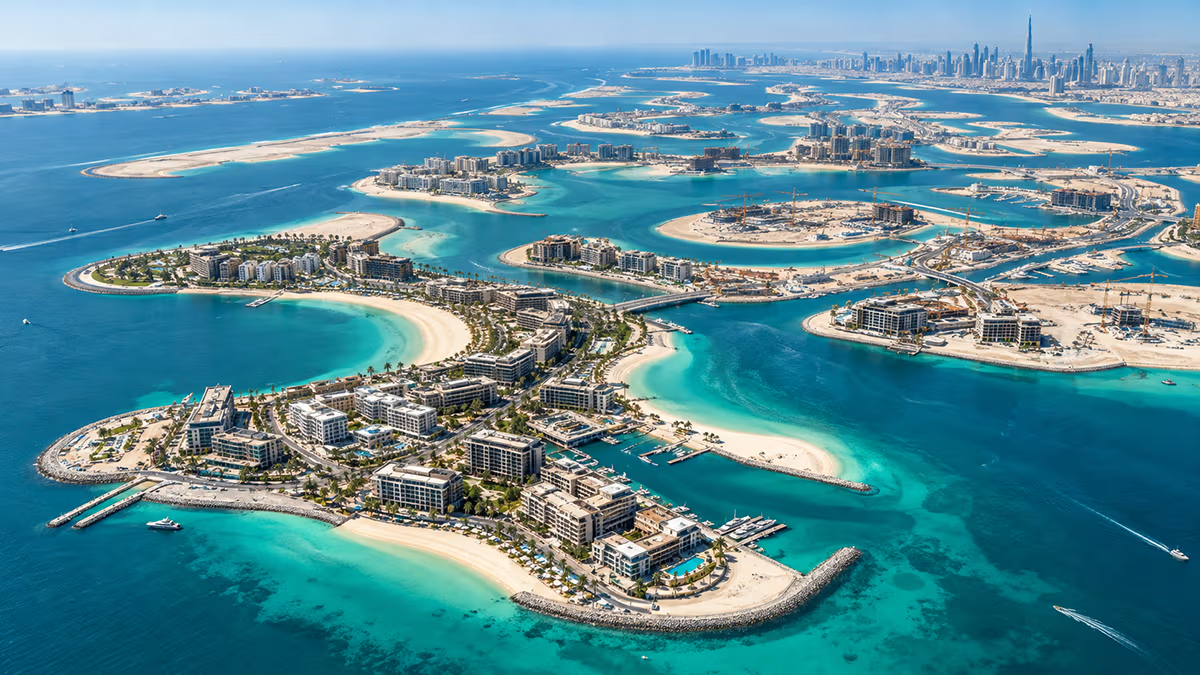
The off plan advantages for luxury properties are clearest where land is scarce. District One Villas, on the lagoon in Mohammed Bin Rashid City, rose from about $411 per square foot at launch in 2022 to $779 in 2026. Peninsula Three, on the water in Business Bay, went from $585 to $727 over the same years. New waterfront districts are following the same path: Dubai Islands recorded 3,547 off-plan deals in 2026 at a median of about $773 per square foot, among the highest of any busy district.
For a buyer at this level, off-plan offers two things a finished home rarely can: the choice of the best units in a scarce location, and a price set before the address is fully built and proven. For a closer look at which premium developers justify their prices, see Which Dubai Premium Projects Are Actually Worth the Price.
Less of a fit if you need the home ready for a specific date, or you want to inspect the finished product before committing a large sum. At this level a completed home in an established community can be the calmer choice.
Risks and Downsides of Off-Plan: When to Think Twice
Off-plan asks for patience and steady finances. The risks are real and, in Dubai, each one comes with a way to check it before you sign.
The completion date can move. It is the developer's target. The Dubai Land Department's Project Status Enquiry shows each registered project's progress, and across Dubai 58% of homes under construction are already 80–100% complete (DXB Interact, October 2026), so many projects are close to the finish line.
The market at handover is unknown. Prices may be higher or lower when you get the keys. Holding through a full rental cycle reduces the weight of any single year; our Dubai property market forecast for 2026–2027 sets out the scenarios.
The developer's record matters. A developer with finished buildings you can visit is the strongest protection you have. If a project is cancelled by the regulator, or work never starts for reasons outside the developer's control, the law requires all purchaser payments to be refunded.
Missing payments has a cost. If a buyer stops paying, the developer must first give 30 days' notice through the Dubai Land Department. After that it may cancel the contract and keep up to 25% of the property's value, or up to 40% once the building is more than 60% complete, and refund the rest within a year, or within 60 days if the unit is resold sooner (Dubai Law No. 13 of 2008, Article 11, as amended in 2020). The rule is fixed by law, which means you can plan for it from the start.
Selling before handover has conditions. Most developers allow a resale only once a set share of the price has been paid, and charge a transfer fee. Our guide to reselling off-plan property covers the rules and the numbers.
No rent until handover. If you need income now, a finished home fits better.
Our guide to assessing off-plan investment risk shows how to check each of these before you sign, and our guide to buying property in Dubai as a foreigner covers the protections that apply at each step.
"A client from the US came to us with a shortlist of off-plan one-bedrooms in Town Square that looked almost identical on paper. Comparing them line by line, on service charges, layouts and the supply due nearby, showed weaknesses in two of them, and he bought the third with a clear reason why it made sense. Most of the risk in off-plan sits in choices you can test before you sign."
Who Off-Plan Suits in 2026
Off-plan suits buyers who can wait for income and spread their payments, and suits less those who need rent or their capital back soon. Four profiles we meet most often:
The first-time investor with $200,000–300,000. Off-plan opens areas such as JVC, Dubai South and Majan with a small first payment and the rest spread over the build. Fits: buyers with steady income who can cover each instalment. Less of a fit if the savings are the whole safety cushion.
The investor adding a second or third property. Off-plan lets you place capital in a new building in a growth area while existing homes keep paying rent. Fits: portfolios that already have income and want a growth asset. Less of a fit if the portfolio needs more cash flow now.
The business owner paying from cash flow. Instalments linked to construction match regular business income better than one large transfer. Fits: owners who want to move capital into a hard asset step by step. Less of a fit if income is seasonal and a payment could fall in a lean month.
The buyer planning to live in Dubai later. Buying off-plan now secures a new home at today's prices for a move in two or three years. Fits: families with a clear relocation date. Less of a fit if the move date is uncertain and the home must be ready on a fixed day.
Should You Buy Off-Plan in 2026? A Six-Question Checklist
Off-plan fits if you can answer yes to most of these questions. The market in 2026 supports the format; the checklist tells you whether it suits your money and your timing.
- Can you wait two to four years before the home earns rent?
- Can you meet every instalment on the plan, even if one falls due in a weaker month for your income?
- Has the developer handed over finished projects you can visit?
- Is the project registered with the Dubai Land Department, with its progress visible online?
- Does the price per square foot make sense next to completed homes in the same area?
- Do you know your exit: live in it, rent it out, or resell once the developer's minimum payment is reached?
If you answered yes to five or six, off-plan suits your plan. Three or four means the project needs a closer look. Fewer than three points to a finished home, at least for now.
Taken together, the evidence points one way: in Dubai, buying off-plan has paid most buyers who chose well and waited, and 2026 gives them a steadier launch market to choose from. The return still sits in the building, so spend your time on that decision.
Five Things to Remember About Buying Off-Plan in Dubai
- The record of recent launches is encouraging, and it is a record of buildings, so judge each one on its own.
- Off-plan suits buyers who value a light entry and can wait for income.
- Payments are protected by escrow, and progress can be checked before you sign.
- Steady finances matter as much as the right project.
- Know your exit before you sign: live, rent or resell.
FAQ
Is it worth buying off-plan property in Dubai in 2026?
For buyers who can wait for rental income and choose a developer with a strong delivery record, yes. Most projects launched in 2022 that we tracked are worth more per square foot today than at launch.
What are the benefits of buying off-plan in Dubai?
A small deposit, payments spread over construction, the first choice of units, a new home, and the chance of price growth before handover, with payments held in escrow by law.
What happens if an off-plan project is delayed?
Your contract sets the completion date and any grace period, and you can follow the project's progress on the Dubai Land Department website. If the regulator cancels a project, the developer must refund all purchaser payments under Dubai law.
Do off-plan properties appreciate before handover?
Often, though it depends on the project. Of the 15 projects launched in 2022 that we tracked, 13 traded above their launch price per square foot in 2026, with a median rise of 33%.