Dubai South Area Guide: Investment Case, Prices and Buyer Scenarios in 2026

Dubai South is becoming harder to ignore: the district already has more than 4,200 operating businesses, added 653 new companies in 2025, and sits next to the future Al Maktoum International Airport, planned to handle up to 260 million passengers a year.
Is Dubai South still too early — or is this the stage where the better entry points start to disappear?
And if prices look more accessible than in Dubai’s mature districts, is that a genuine timing advantage or a liquidity risk in disguise?
This guide looks at where Dubai South makes sense, where the risks sit, and which buyer scenarios are worth considering before you shortlist a project.
Dubai South in 2026: Early Access or Early Risk?
Dubai South is already past the pure concept stage. The area has an operating business base, logistics activity, residential delivery and aviation infrastructure under construction.
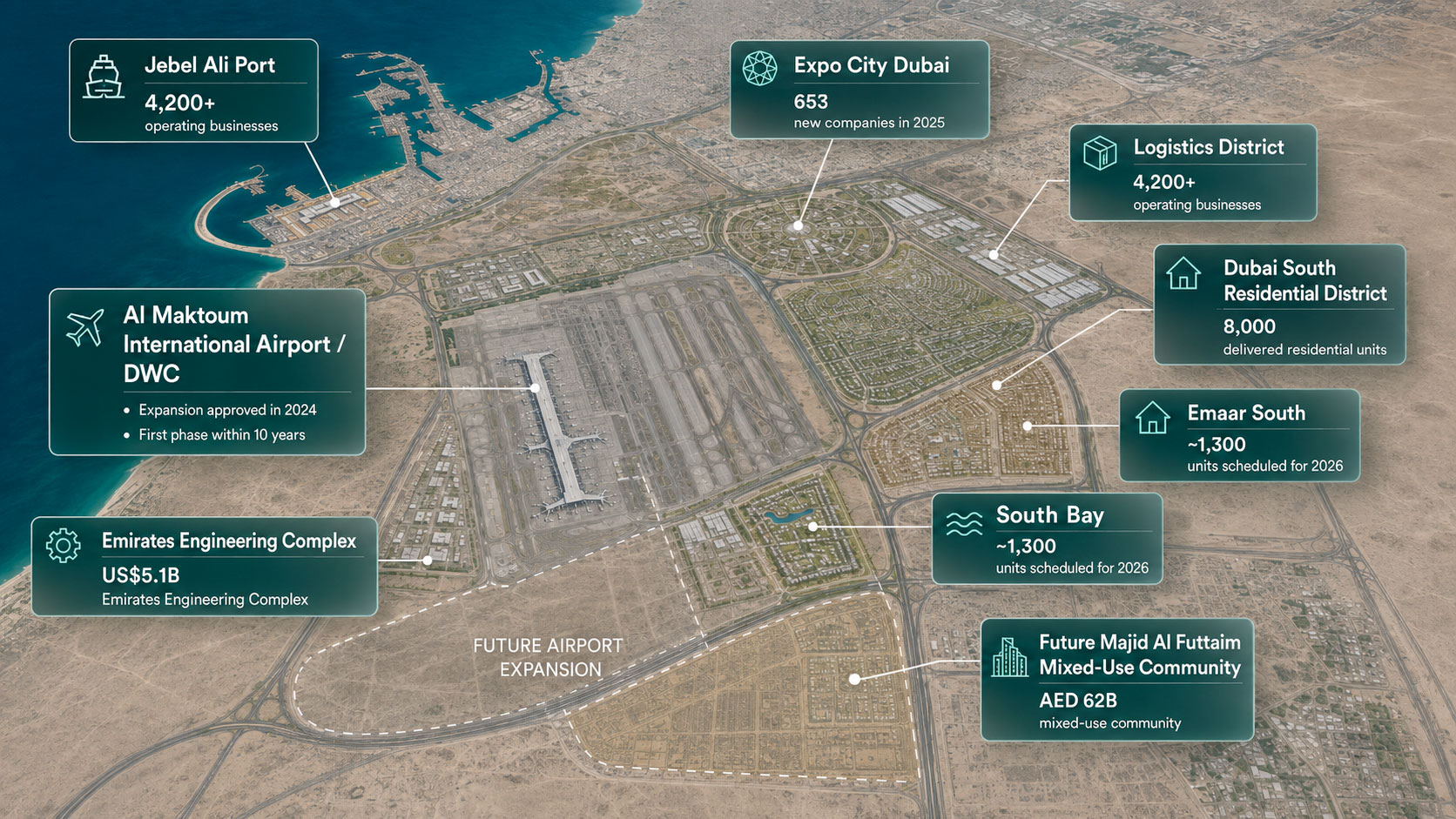
The opportunity sits in the gap between what is already active and what the district may become once the airport, retail and community layers deepen. That gap can create better entry points, while also making weak selection more expensive.
Dubai South is attractive because the district is still being priced before its full airport, retail, residential and lifestyle ecosystem is complete.
For investors, this creates a timing question. Are you entering before the next layer of demand becomes visible — or buying into a location that may take longer to mature than expected?
Dubai South: Built, Building, Future
Data compiled by Mint Elite Real Estate from official sources: Dubai South, Emirates and Dubai Media Office
Dubai South is already active enough to take seriously, but it is still developing. The better opportunities are likely to be properties where the current price still reflects the area’s unfinished stage. Buyers should be cautious with units that are already priced as if the airport expansion, retail, schools, services and lifestyle infrastructure were fully in place.
Mint asset managers filter every Dubai South opportunity through three questions before it reaches the shortlist:
- Who is the future tenant or buyer?
Airport-linked professional, logistics worker, family buyer, investor or lifestyle-led renter? - Can the payment plan and holding period absorb a slower maturity cycle?
The area may need more time before infrastructure, rental depth and resale liquidity fully catch up. - Is the unit liquid on its own if the district takes longer to mature?
Layout, size, floor, view, service charges and resale pool all need to support the investment case.
What Could Create Demand Around Dubai South?
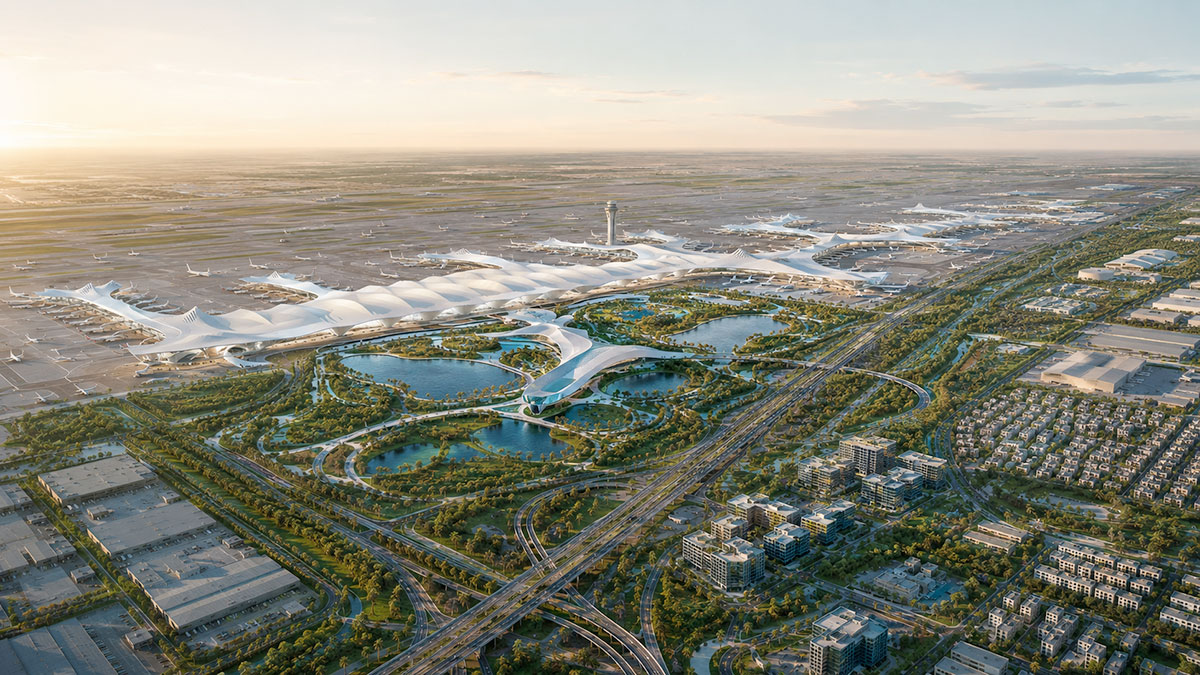
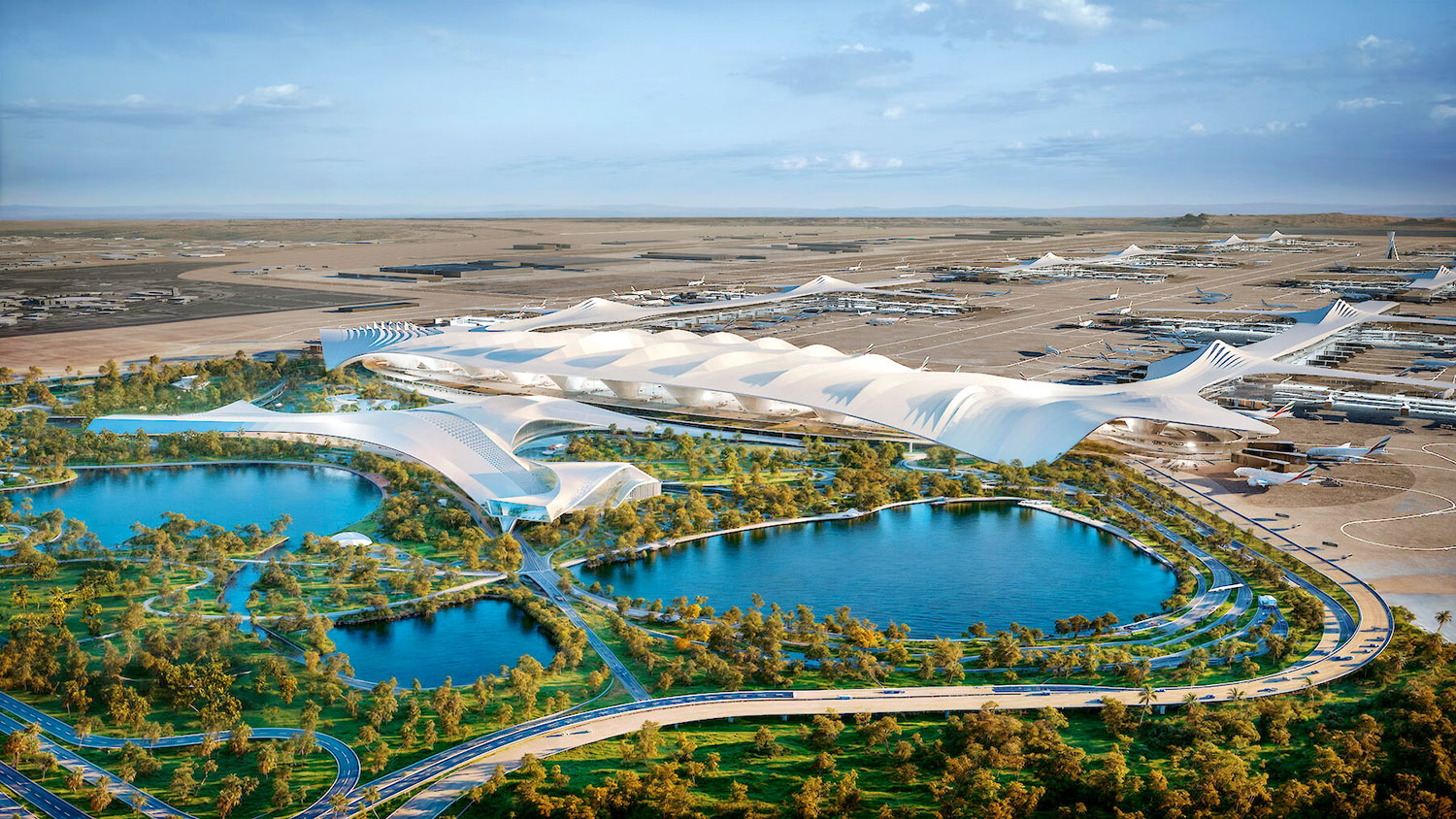
Al Maktoum International Airport is the largest long-term anchor. In April 2024, Dubai approved the new AED 128 billion passenger terminal at Al Maktoum International Airport.
The first phase is expected within 10 years, with capacity for 150 million passengers annually; the ultimate plan reaches up to 260 million passengers, 400 gates and five runways. Dubai Media Office also states that the airport expansion is expected to generate workforce and residential requirements for more than one million people living and working in Dubai South.
Dubai Exhibition Centre adds a near-to-mid-term events engine. Dubai approved an AED 10 billion expansion plan for Dubai Exhibition Centre at Expo City.
Phase 1 is set for completion by 2026 with 140,000 sq.m of exhibition space; the final phase is expected by 2031 with 180,000 sq.m and a target to grow large-scale events from around 300 today to more than 600 annually by 2033.
For scale, Al Maktoum International Airport’s ultimate planned capacity of up to 260 million passengers a year would place it far above today’s busiest global aviation hubs. This is future capacity, not current traffic, so it should be read as a long-term infrastructure benchmark.
- Al Maktoum International Airport: planned ultimate capacity of up to 260M passengers a year
- Hartsfield-Jackson Atlanta: 106.3M passengers in 2025
- Dubai International Airport: 95.2M passengers in 2025
- London Heathrow: 84.5M passengers in 2025
- Istanbul Airport: over 84M passengers in 2025
- New York JFK: 62.6M passengers in 2025
Expo City creates a planned professional and residential base next to Dubai South. The Expo City master plan is designed to welcome more than 35,000 residents and 40,000 professionals, with homes, offices, event venues, amenities, green spaces and smart transport infrastructure. It also has a dedicated Dubai Metro station and access to major highways.
The logistics ecosystem is already forming around named operators. Dubai South reported logistics activity involving Expeditors, Ford, DHL and UPS in 2025. Its Logistics District is positioned around Al Maktoum International Airport, Jebel Ali Port, cargo terminals, EZDubai and the Contract Logistics Zone.
Aviation infrastructure is moving beyond the airport terminal story. Emirates started construction of a US$5.1 billion engineering complex at Dubai South in May 2026. The facility is planned to span 1.1 million sq.m, handle 28 wide-body aircraft simultaneously and complete by mid-2030.
Retail and daily-life infrastructure is being added in layers. Dubai South announced South Bay Mall as a 200,000 sq.ft retail and lifestyle destination in the Residential District, while Dubai Media Office announced an AED 62 billion, 22 million sq.ft Majid Al Futtaim mixed-use master community in Dubai South.
Dubai South’s location should be judged by demand pools, not only by distance from central Dubai. The useful question for investors is simple: who may need to live, work or rent here — and whether the specific project matches their budget, commute and daily-use needs.
Dubai South Demand Map: Who Could Actually Need This Location?
The logistics FTE range is a Mint estimate based on publicly announced floor areas of named Dubai South logistics facilities and storage / distribution employment-density benchmarks of roughly 77–95 sq.m per FTE. Business-base figures are shown as activity signals, not employee counts
Dubai South already has a real residential base: more than 30,000 people live in its Residential District today. That gives the area a working community, although it remains much less mature than Dubai Marina / Marsa Dubai, which has 70,550 residents and a far more established daily-life ecosystem.
The wider Dubai South / Expo City corridor could become significantly larger over time, especially once Expo City’s planned 35,000+ residents and 40,000 professionals are added. For investors, the practical point is to separate existing demand from demand linked to future delivery.
"“Dubai South should be assessed as several demand stories, not one broad location bet. The area already has 30,000+ residents and 4,200+ operating businesses, while Expo City could add 35,000+ residents and 40,000 professionals over time. For buyers, the key question is specific: who is this unit for — an Expo City professional, a family, a logistics-linked tenant or a long-horizon resale buyer?”"

What Mature Dubai Districts Show About Early Entry
Some Dubai districts were once harder to understand than they are today. They had fewer residents, less infrastructure, fewer services and less resale evidence.
Over time, the stronger areas became easier to live in, easier to rent out and easier to sell. As that happened, prices moved higher.
Dubai South is still at an earlier stage. The question for buyers is whether today’s lower price reflects a real entry advantage — or whether the area still needs more time before demand becomes deeper and more predictable.
How Mature Dubai Districts Repriced Over Time
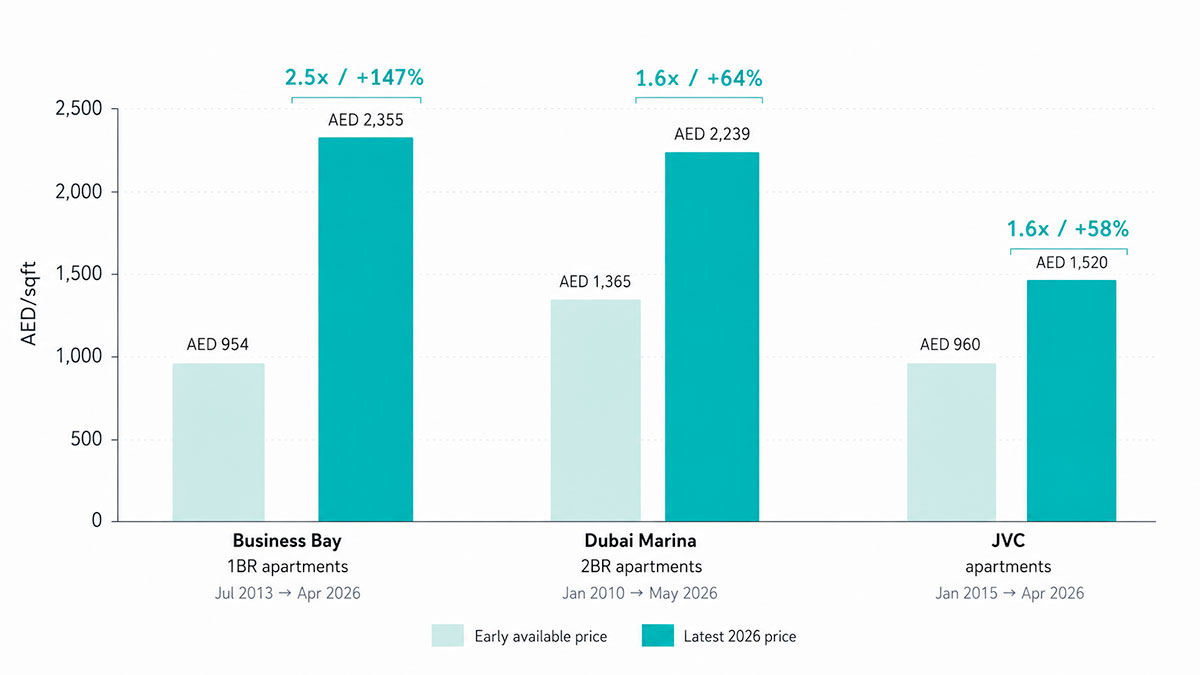
This chart gives useful context for Dubai South. It shows how much pricing can change when an area gains stronger infrastructure, tenants, daily-life demand and resale activity.
Dubai South already has some of those pieces in place, but its market is still developing. Its current indexed price remains closer to an expansion district than to Dubai’s most liquid mature markets.
Dubai South Price Scenarios: 2026–2034
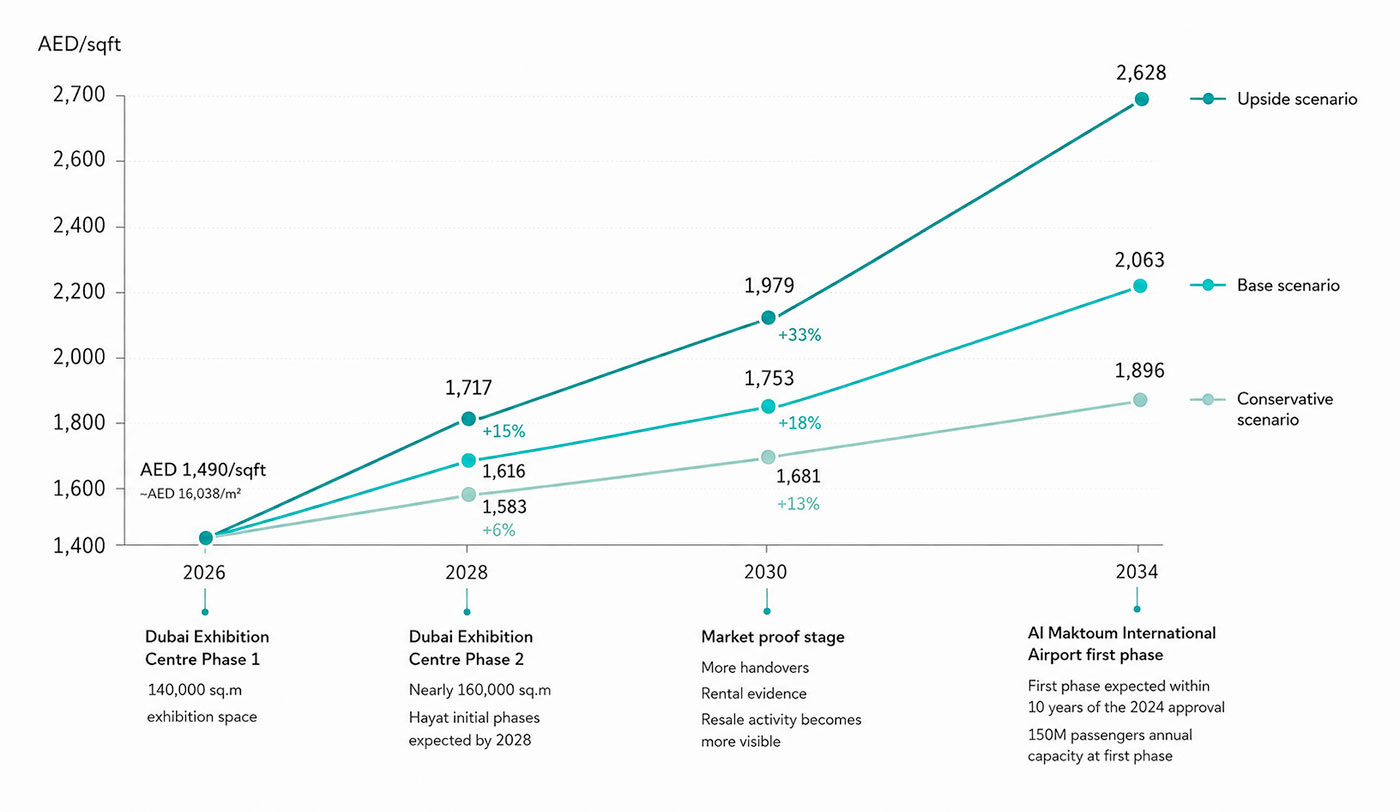
The timeline starts from Dubai South’s current Bayut indexed price and applies three historical growth patterns seen in more mature Dubai districts: conservative, base and upside. The milestones show when demand could become stronger. They do not mean prices will automatically rise. This is Mint’s internal scenario framework, not an investment recommendation.
The timeline should be read as a stress test. The higher scenarios only become realistic if Dubai South starts showing clearer market evidence: stronger rents, repeat resales, better daily infrastructure, controlled service charges and demand for specific buildings.
For buyers, the main point is simple: Dubai South may offer early-entry potential, but the area story is not enough.
A good purchase still has to work at unit level — by price, product type, tenant profile, payment plan and future resale audience.
Dubai South Buyer Fit Matrix: Price, Use Case and Exit Risk
Dubai South should be filtered by buyer route before a project is shortlisted. A family buyer, a rental-income investor and a long-horizon growth buyer are exposed to different risks, even inside the same district.
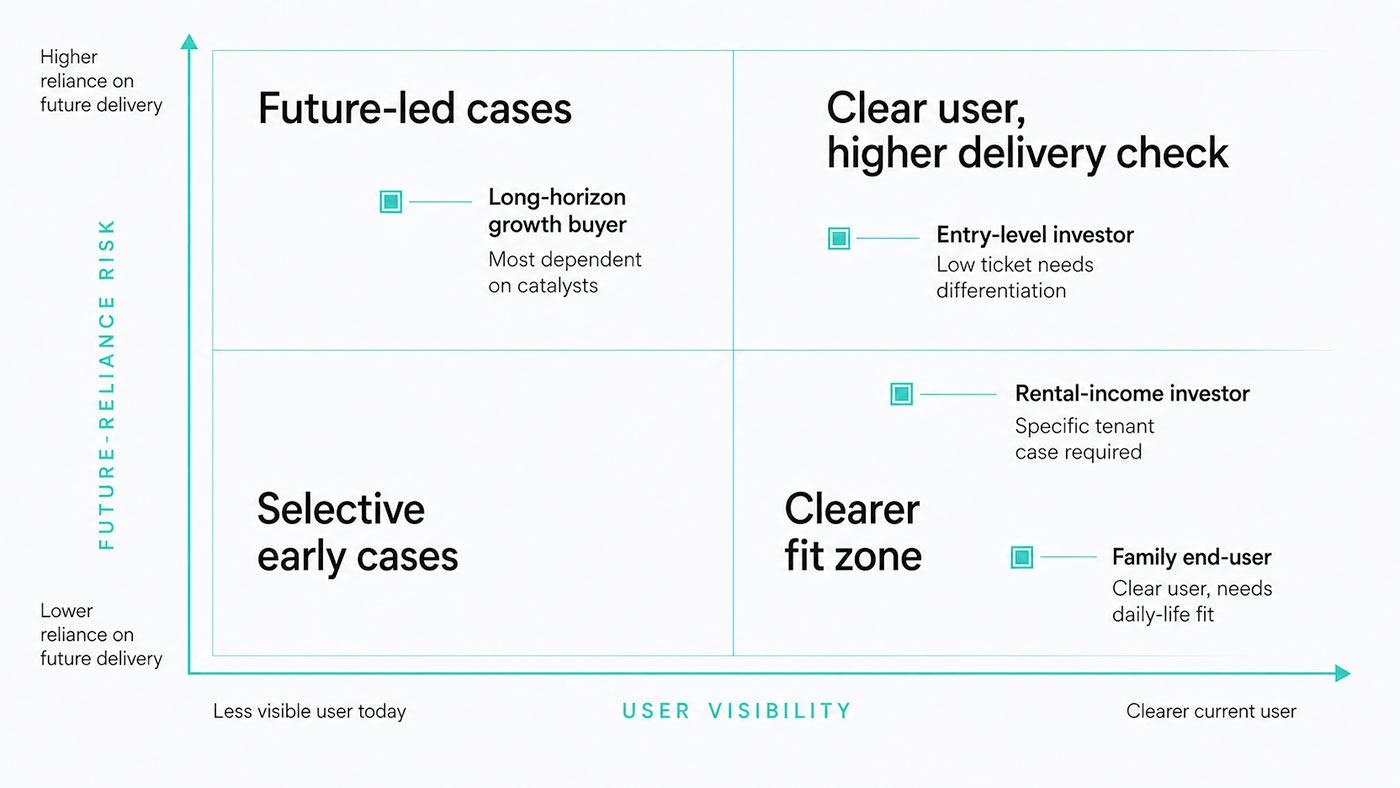
How to read it. The bottom-right zone is the clearest fit: the user is easier to define, and the purchase depends less on future delivery. The top-left zone carries more uncertainty: the buyer is relying more heavily on catalysts such as airport growth, infrastructure delivery, community maturity and future resale demand.
The strongest routes have a clear user and a credible second buyer. The weaker routes rely on a general district story without a precise answer to who rents the unit, why this building wins against similar stock, and who buys it next.
This is why project-level comparison matters. In Dubai South, the investment case becomes serious only when price, product, tenant logic and exit audience line up at unit level.
3 Representative Project Routes in Dubai South
There are three different ways to enter Dubai South — each with its own buyer logic, price point and risk profile. Final selection still depends on live availability, service charges, floor plan quality, payment-plan rhythm and resale competition.
1. Golf Vale by Emaar — branded master-community exposure
Key facts:
- Current 2BR availability from AED 1.56M
- 1–3BR apartments and 3BR townhouses
- Approximately 262 units — to be verified against the Emaar brochure before publication
- Expected completion Q1 2030 — to be verified against developer materials
Golf Vale gives buyers exposure to Emaar South, one of the more recognisable residential communities within Dubai South. The wider Emaar South master community includes apartment stock, retail and dining space, neighbourhood parks and an 18-hole championship golf course.
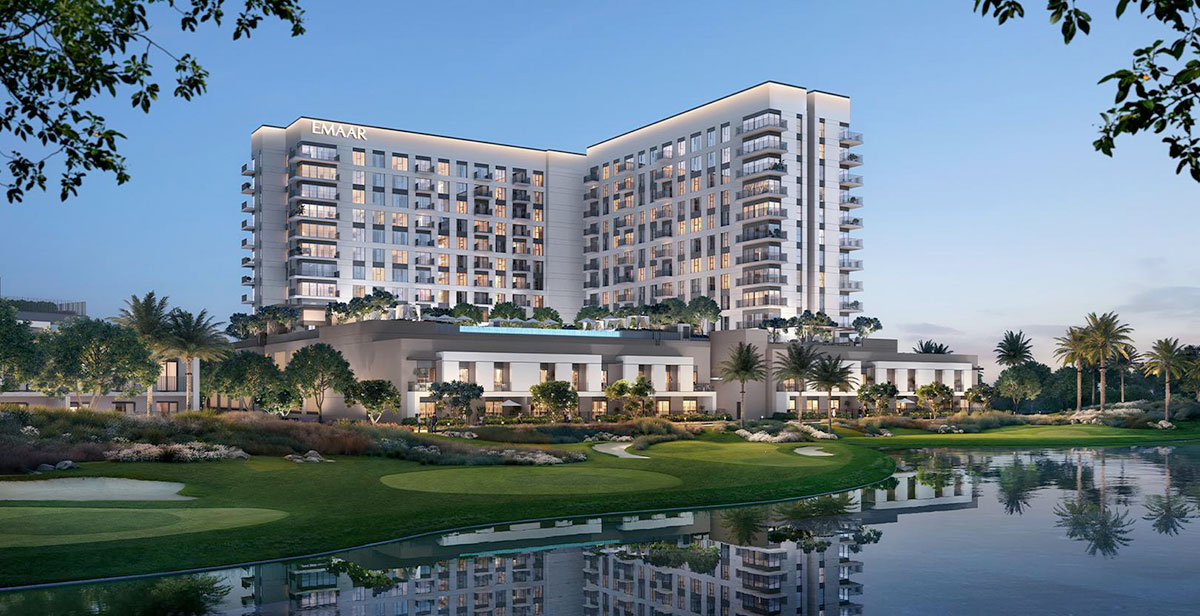
Investment angle: this is the brand-led route. Emaar gives the project a clearer resale conversation, while the golf-community setting helps the product stand apart from basic apartment inventory in Dubai South.
Best fit: buyers who want Dubai South exposure with a stronger developer name, a more familiar lifestyle proposition and a cleaner explanation to the next buyer.
Risk check: the brand cannot carry the whole investment case. The entry price still needs to leave room for Dubai South’s maturity risk, future Emaar South supply and direct competition from similar golf-facing stock.
2. Hayat by Dubai South — family-scale community play
Key facts:
- Approximately 2,500 residential units across the wider Hayat master community
- Current townhouse availability from AED 3.75M for 3BR
- 4BR from AED 4.5M; 5BR from AED 5.9M
- Current availability shows completion in Q1 2029
Hayat represents a larger-format Dubai South route. It is planned as a 10 million sq.ft master community with townhouses, villas, mansions, apartments and hotel apartments, supported by parks, shaded walking trails, play areas, wellness facilities, community pools, lagoons, retail and daily conveniences.
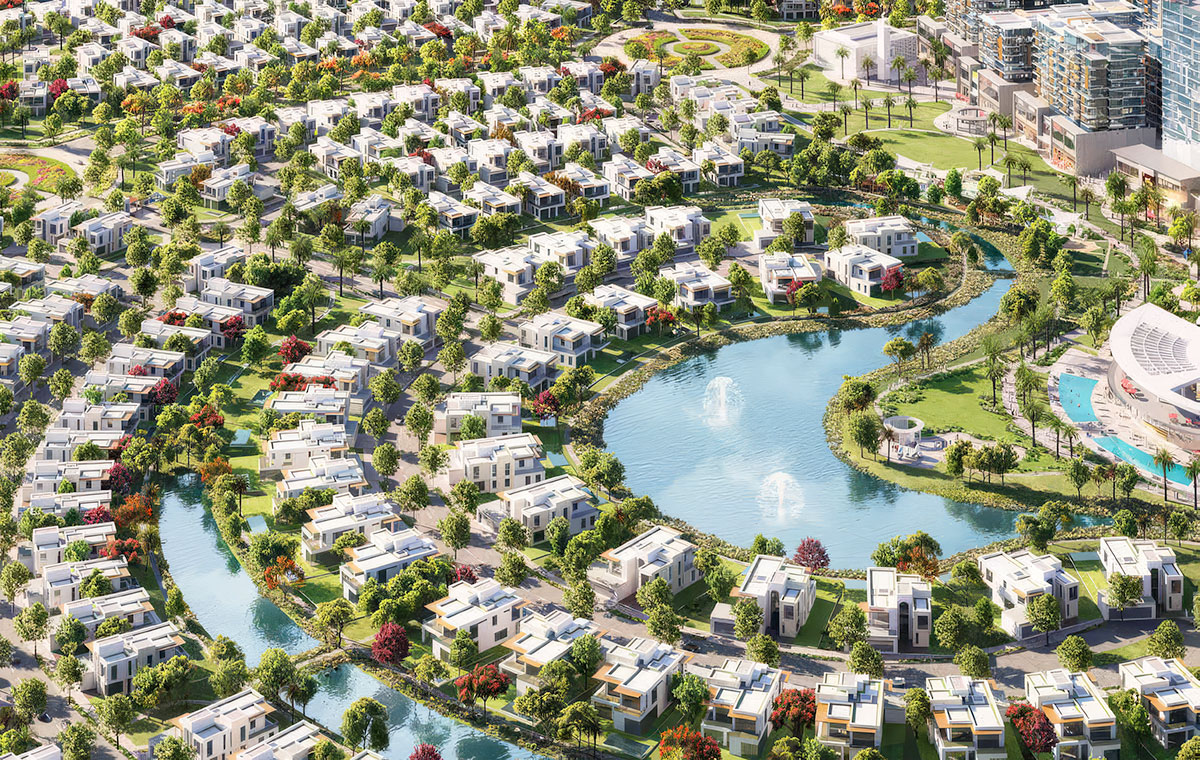
Investment angle: this is the family-community route. The product speaks to buyers looking for space, privacy, outdoor living and a fuller residential environment rather than a compact rental ticket.
Best fit: end-user families, long-horizon buyers and investors who believe Dubai South can grow into a more established residential base over time.
Risk check: family demand needs daily-life proof. Roads, retail, schools, services, landscaping and community management matter more here than macro headlines about the airport or Expo City. If the community layer takes longer to mature, the buyer carries that waiting risk.
3. Enre Residence by Imtiaz — compact rental-oriented entry
Key facts:
- Around 170 units
- Studios, 1BR and 2BR apartments
- 60/40 payment plan
- Current residential availability from AED 1.20M for 1BR and AED 1.81M for 2BR
- Completion March 2028
Enre Residence gives buyers a smaller-scale apartment route in Dubai South. Its logic is different from Golf Vale and Hayat: the product is more compact, the building scale is easier to read, and the investment case depends more directly on rental use.
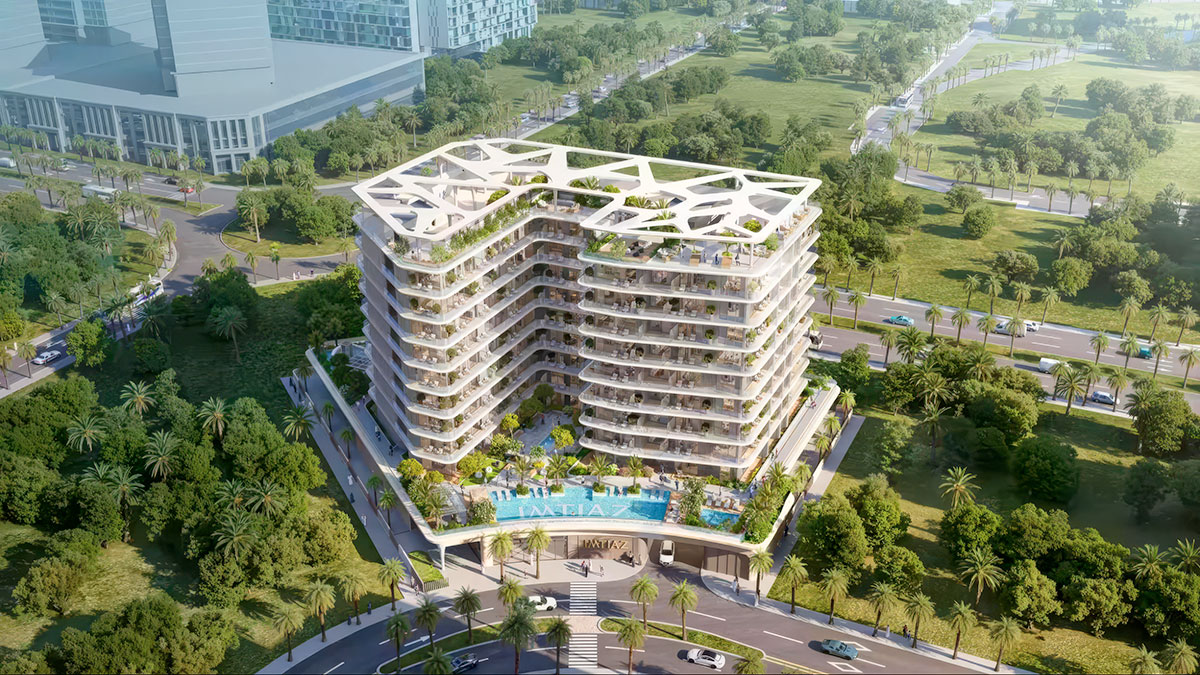
Investment angle: this is the compact, tenant-led route. It can work when the buyer has a specific rental audience in mind: an Expo City professional, a logistics-linked worker, an aviation-related user or a renter seeking a more affordable alternative to central Dubai.
Best fit: investors looking for a manageable entry point, practical unit sizes and a clearer rental-use case.
Risk check: compact apartments are easier to buy, but also easier to overproduce. The unit needs differentiation: efficient layout, parking, furnishing quality, sensible service charges and a reason to compete well against similar stock at handover.
What These Three Routes Show
The same Dubai South thesis can produce three very different assets.
Golf Vale is a brand and golf-community route. Hayat is a family-scale community route. Enre Residence is a compact rental route. Each one can make sense, but only if the buyer’s budget, holding period and exit audience match the product.
For Mint, the shortlist starts with this question: what kind of risk is the buyer taking? Brand premium, community delivery, rental depth and resale competition are different risks. Treating them as one generic Dubai South opportunity is where weak purchases usually begin.
Five Things to Remember
- Dubai South is no longer just a future map.
The area already has residents, businesses, logistics activity, residential delivery and large infrastructure commitments. The question is how quickly these pieces turn into deeper rental demand and resale liquidity. - The airport matters, but timing matters more.
Al Maktoum International Airport is the biggest long-term catalyst, yet its full impact will come in stages. Buyers should price Dubai South as a long-cycle infrastructure play, not as an immediate airport premium. - Demand is fragmented — and that changes the buying logic.
A family buyer, an Expo City professional, a logistics-linked tenant and a long-horizon resale buyer do not need the same product. The stronger purchase is the one with a clear user from day one. - Different projects carry different risks.
Golf Vale is a brand and golf-community route. Hayat is a family-community route. Enre Residence is a compact rental route. Comparing them as generic «Dubai South projects» misses the real investment question. - The unit still has to prove itself.
Dubai South may offer early-entry potential, but a weak unit will not be saved by the masterplan. Price, layout, payment plan, service charges, tenant logic and exit audience decide whether the opportunity is investable.
FAQ
Is Dubai South a good area to invest in?
Dubai South can be a good fit for buyers with a medium- to long-term horizon. The area has major growth drivers, but it is still maturing, so the best opportunities are likely to be project-specific rather than district-wide.
Is Dubai South still too early?
Dubai South is still earlier than areas such as Dubai Marina, Business Bay or JVC. That creates both the opportunity and the risk: buyers may enter before the area is fully priced as a mature market, but they also carry more delivery, rental and resale uncertainty.
What is the current property price in Dubai South?
Bayut’s May 2026 index shows Dubai South at around AED 1,490 per square foot, or roughly AED 16,000 per square metre. This places it below many mature Dubai districts, but the lower price should be read together with the area’s still-developing infrastructure and liquidity.
Is Al Maktoum International Airport already driving prices?
The airport is the largest long-term catalyst, but its full impact is not immediate. The new passenger terminal was approved in 2024, and the first phase is expected within 10 years. Buyers should treat the airport as a long-cycle driver, not as a short-term price trigger.
Who is likely to rent in Dubai South?
Likely tenant groups include Expo City professionals, aviation-related users, logistics-linked workers, Dubai South business users, families seeking more space and renters looking for better value than in central Dubai.
What type of property works best in Dubai South?
There is no single best product. Compact apartments may suit rental-income buyers, townhouses may suit families, and branded community projects may work better for buyers who care about resale readability. The right choice depends on budget, holding period and exit plan.
What are the main risks of buying in Dubai South?
The main risks are slow resale, too much similar supply, weak daily infrastructure around a specific project, high service charges, optimistic rent assumptions and paying too much for future growth before it appears in real market demand.
Should I buy off-plan or ready property in Dubai South?
Off-plan can offer staged payments and earlier entry pricing, but it carries delivery and future-supply risk. Ready property gives clearer rental and resale evidence, but may offer less upside. The better choice depends on cash flow, risk tolerance and investment horizon.
How should I compare Dubai South projects?
Start with the unit, not the brochure. Compare entry price, payment plan, handover timeline, developer track record, layout efficiency, service charges, likely tenant, resale audience and how much similar stock will compete with it.
Disclaimer
This article is for informational and analytical purposes only. It does not constitute investment, financial or legal advice. Price scenarios are internal Mint modelling assumptions, not guaranteed forecasts. Buyers should verify current prices, availability, payment terms, legal documents and project details before making a purchase decision.