How Much Can You Really Earn from Rental Income in Dubai?
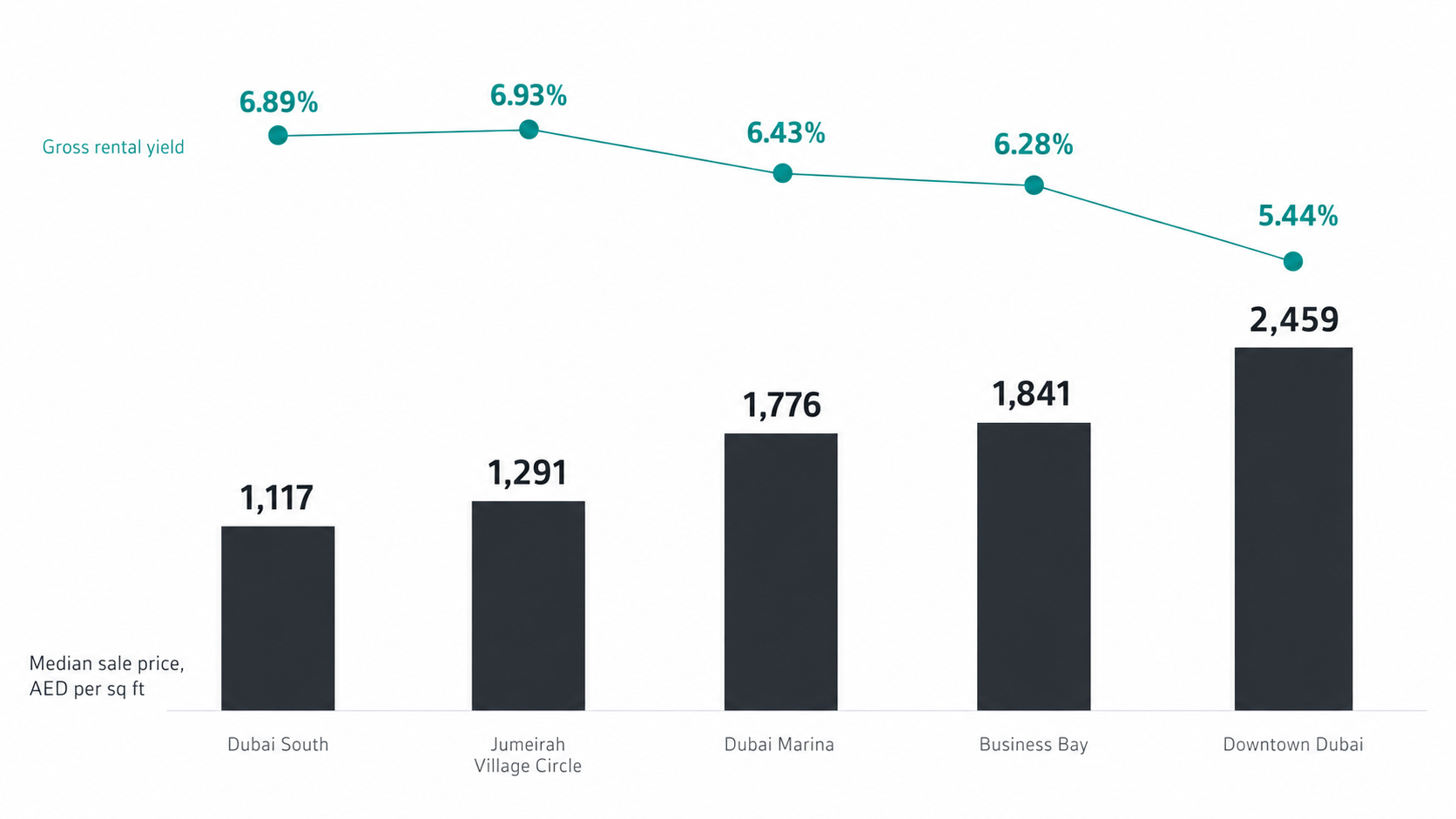
A Downtown apartment costs nearly twice as much per square foot as one in Jumeirah Village Circle, and it returns about a fifth less for the money.
Across Dubai's five most active rental districts, gross yields sit between 5.4% and 6.9%. Gross yield is the year's rent set against what the property cost. Both halves of that calculation come from Dubai Land Department records: sale prices for completed homes, and rents from contracts registered with Ejari, the government tenancy register, from January to July 2026.
This page shows where the range comes from and what is left of it after the owner has paid. It sits alongside our wider guide to why investors buy in Dubai.


What Dubai Property Investment Returns Look Like in 2026
These figures come from two Dubai Land Department records rather than from advertised asking prices.
Rent is the median on new Ejari contracts registered between January and July 2026.
Price is the median for completed homes sold in the same months. Off-plan sales sit outside the calculation, because a property still under construction cannot be let.
Published yields often sit higher than this. Dubai South is quoted at 10.0% by DXB Interact. The registered contracts in that district point to 6.89%, and no combination of rents in the data reaches the higher figure.
A one-bedroom apartment in Jumeirah Village Circle shows the scale:
- Size: 803 sq ft
- Purchase price: AED 1,006,159 (USD 273,971)
- Annual rent, newly let: AED 73,000 (USD 19,877)
- Gross yield: 7.26%
Dubai Property ROI by Unit Type and District
The smaller the home, the higher the return. This holds in every district measured, without exception.
Capital moves in the opposite direction: a studio in JVC costs around USD 161,800 and pays 8.36%, a one-bedroom in Business Bay around USD 419,000 and pays 6.04%.
The cheaper unit is not automatically the better one. Downtown buys liquidity and depth of resale rather than income, which matters more to an owner who may sell within a few years than the extra point of yield does. Compare current listings district by district in our property catalogue.
Every figure here is measured before costs, and whether the studio advantage survives them depends on the individual building, since service charges are approved project by project.
Gross vs Net: What Actually Reaches Your Account
The service charge alone takes between 11% and 16% of the rent, depending on the district. It is the first deduction, and in most published return figures it is missing.
The district figure hides more than it shows. Downtown ranges from AED 17 per sq ft in a standard tower to nearly AED 68 in the Burj Khalifa. At the low end the net yield is 4.75%; at AED 40 it falls to 3.82%. Picking the wrong building inside one district costs more than picking the wrong district.
"Inside Downtown alone the approved rate runs from AED 17 per square foot to nearly AED 68. That spread is wider than the entire distance between Downtown and Business Bay. The address gives you the range. The building gives you the number."
Four other costs sit behind the service charge:
- Letting commission — paid by the tenant in Dubai. For the owner, this line is zero.
- Maintenance and repairs inside the unit — no public dataset covers this. Any figure quoted for it is an assumption, including ours.
- Vacant months between tenants — the Ejari register records contracts, not the gaps, so this cannot be measured from official data.
- Property management — optional on an annual contract, and priced separately if you use it.
Two of those four cannot be measured at all. Rather than fill them with plausible percentages, the calculation below shows what each one costs when you change it.
Return on Property Investment in Dubai: A Worked Example
A one-bedroom apartment in Jumeirah Village Circle, bought completed and let on an annual contract, returns 6.09% after costs. The headline figure for the same flat is 7.26%.
- Purchase price — AED 1,006,159 (USD 273,971) for 803 sq ft, the median for a completed one-bedroom in JVC between January and July 2026.
- Annual rent, newly let — AED 73,000 (USD 19,877).
- Service charge — minus AED 8,030, at AED 10 per sq ft.
- Maintenance and repairs — minus AED 3,650. This is an assumption of 5% of rent. No public dataset measures it, so treat the line as a placeholder for your own quote.
- Letting commission — AED 0. The tenant pays it.
- Net income — AED 61,320 (USD 16,697).
Empty months move the answer further than any other line:
A single empty month costs 0.60 percentage points, almost the entire gap between JVC and Dubai Marina. No one can tell you how long your flat will stand empty. What the table gives you instead is the price of each month.
Short-Term vs Long-Term Rental in Dubai
Every figure in this article describes long-term letting. A Dubai home rented for less than six months at a time is a holiday home under Decree No. 41 of 2013 and needs a permit from the Department of Economy and Tourism.
An annual Ejari tenancy does not cover short stays. They are two separate legal channels for the same apartment, which is why short lets sit outside the data above and why no public source publishes occupancy or nightly rates for them.
- You can hold the permit yourself. An individual owner registers directly with DET, commonly for up to eight self-managed units, without forming a company. A trade licence applies to managing other people's property.
- The fees are small. The furniture is not. DET registration is a one-off of about AED 1,520, and the annual unit permit starts near AED 370 for a studio. Furnishing to DET's standard is capital that never appears in any gross yield figure.
- Tourism Dirham passes through your hands: AED 10 to 15 per occupied bedroom per night, collected from the guest and filed monthly.
- Your building can refuse. Freehold ownership does not override an owners association that restricts short lets. Confirm that before you budget for furniture.
How to Improve Your ROI on Property in Dubai
The decisions that move the number most are made before you sign, not after.
- Size down rather than up. Smaller homes pay more in every district measured, and the same capital placed in two studios instead of one two-bedroom spreads the vacancy risk across two tenancies.
- Read the service charge before the brochure. It is the only owner cost you can verify in advance, and it is approved building by building through Mollak, the Land Department's escrow and service charge system.
- Ask what is being built next door. Dubai South has 21.3 times its current apartment stock sitting in the announced pipeline. Announced is not delivered, and roughly half of Dubai's off-plan projects run late, but supply on that scale still weighs on rents for years.
- Keep the tenant you have. Just over half of apartment contracts registered in 2026 were renewals. Every turnover risks empty months, and after the service charge those months are the largest thing standing between gross and net.
None of this requires a view on where the market goes. Each decision is made from documents you can ask for in the week before you sign — the building's Mollak record, the community's supply map, the rent history of the unit itself. That is the share of the return you control.
The rest belongs to the market, and it will do what it does regardless of what any forecast promised.
Rental Income in Dubai: Five Things to Remember
- Check what the quoted yield includes. Most figures stop at rent against price, before any costs.
- Get the building's service charge in writing. It is approved tower by tower, and neighbours bill very differently.
- Budget for empty months yourself. No register records vacancy, so every figure you are handed is someone's estimate.
- Check who pays what before comparing with home. The tenant pays the letting commission here, and there is no annual property tax.
- Treat short letting as its own decision. It needs a separate DET permit, and your owners association can prohibit it outright.
FAQ
How much rental income can you earn in Dubai?
The median apartment newly let in Dubai in 2026 registered AED 75,000 a year, about USD 20,422, on a median size of 799 sq ft. What you keep depends on the building: the service charge alone takes between 11% and 16% of that rent across the districts measured here.
What is the average rental yield in Dubai?
A single city average hides more than it explains. Across the five districts in this article, gross yields vary by roughly a third from top to bottom, and after the service charge the same districts land between 4.6% and 6.2%. The district sets the range; the building sets where in it you land.
Is rental income taxed in Dubai?
The UAE levies no personal income tax, and Cabinet Decision No. 49 of 2023 excludes real estate investment income earned by an individual in a personal capacity from corporate tax. Two conditions matter. The exclusion is written for activity that does not require a licence, so short letting under a DET permit is worth confirming with a tax adviser. And your own country of tax residence may tax the income regardless of what Dubai does.
What costs reduce rental returns in Dubai?
The service charge first and by a wide margin. Then the months between tenants, repairs inside the unit, insurance, and property management if you use it. The letting commission does not appear on this list in Dubai, because the tenant pays it.