Best Areas to Invest in Dubai in 2026
The same dollar earns 8% a year in Dubai Silicon Oasis and 5.5% in Downtown Dubai — at almost three times the price per square foot. The district is the first investment decision you make in Dubai, and it sets your risk before it sets your return.
Dubai closed 2025 with USD 249.7 billion in property transactions and added USD 114.3 billion more in the first half of 2026. This page ranks the 20 most in-demand districts, compares their prices and yields on one consistent dataset, and links a full deep-dive guide for every area we cover.

How Is Dubai Organised for Property Investors?
Dubai is officially divided into 226 communities, but an investor needs only four zones to read the map. Foreign buyers can own property outright in more than 60 designated freehold areas — a list that began with 23 communities under Regulation No. 3 of 2006 and keeps expanding by decree. Every district in this guide sits inside that freehold layer; how the purchase itself works — costs, mortgages, escrow and title — is covered step by step in our guide to buying property in Dubai.
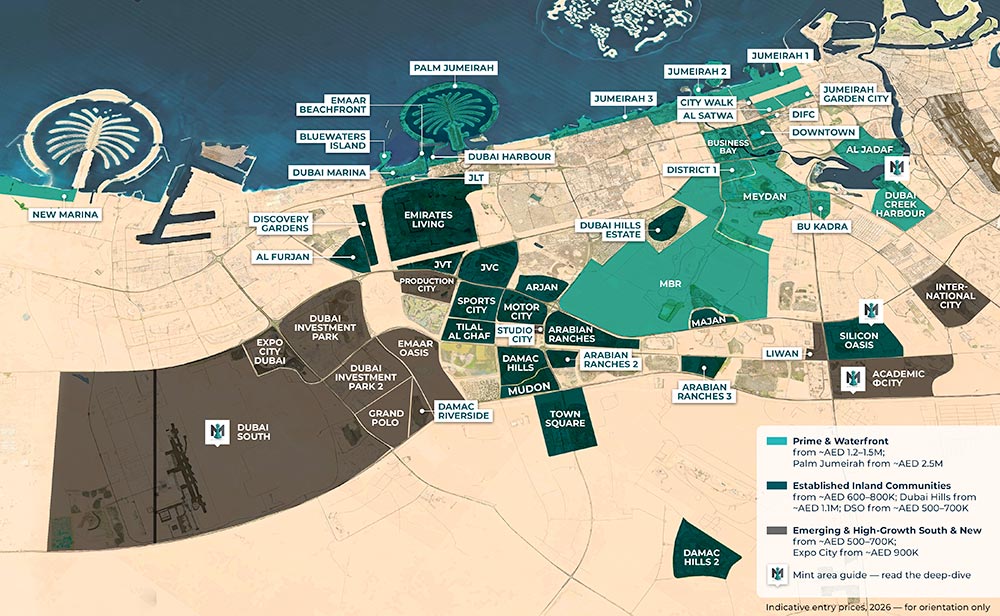
The central core — Downtown Dubai and Business Bay — is the city's liquidity engine: the highest concentration of offices, hotels and short-stay demand, prime prices from USD 578 to 866 per sq ft, and gross yields in the 5.5–6.3% band.
The coastal line runs from Dubai Marina through Palm Jumeirah to Dubai Creek Harbour and the emerging Dubai Islands. This is where Dubai stores value: waterfront scarcity, brand-name developers and the buyers least sensitive to price. Yields are the city's lowest, at roughly 4–6%; resale depth and price stability are what the premium pays for.
The southern growth corridor — Dubai South, Expo City and Dubai Investment Park — is priced before its infrastructure arrives. Al Maktoum International Airport anchors the two-decade case; apartments still trade near USD 324 per sq ft.
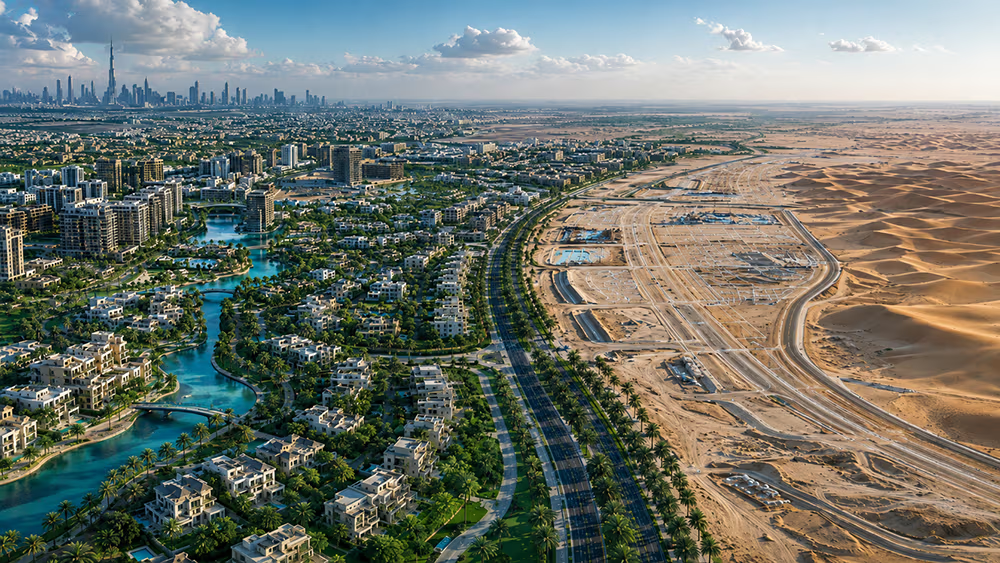
The established mid-market belt wraps around the centre: JVC, Arjan, Dubai Sports City and Dubai Silicon Oasis for apartments; Dubai Hills Estate, Arabian Ranches, Dubailand and the Academic City corridor for villas and family living. This belt generates the city's highest gross apartment yields, at 7–8%, and its highest transaction counts.
This page tracks the 20 most in-demand districts across those four zones, selected by one measure: registered sales activity, the hardest signal of demand there is. Districts enter the list when buyers vote with transactions; our deep-dive guides then follow, area by area. The list reflects H1 2026 and grows as new districts earn their place.
Which Areas Lead Dubai Property Sales in 2026?
Dubai South sold 12,201 new apartments in the past year — more than any district in the city, and 85.5% more than the year before. Transaction registers split demand into two signals: new-build sales show where growth money is going, resale volume shows where owners can exit. A district that ranks on both lists gives you demand today and liquidity tomorrow.
Apartments: where buyers bought (12 months to June 2026)
Villas: where buyers bought (12 months to June 2026)
New-build demand has moved to the growth corridors: Dubai South, Dubailand and Dubai Islands absorb thousands of launch units at $211–330K medians, and every district growing 40%+ sits outside the old centre. Resale liquidity stayed home — JVC, Business Bay, Marina and Downtown are where owners sell fastest, even with volumes down against a record 2025.
Three districts rank top-ten on both lists: JVC, Business Bay and Jebel Ali First. One warning sign reads straight off the villa table: DAMAC Hills 2 resells at half the pace it sells new, and DIP's +1,184% is a single-project base effect, not a trend.
.avif)
Yield falls as price rises, with one exception worth noting: Business Bay pays 6.29% against Marina's 5.88% at the same entry price — short-stay and office demand keep its rents working harder.
.avif)
"In February we sold a client's one-bed in JVC in eleven days. The building had four comparable sales that quarter, so pricing it was arithmetic, and the buyer knew it too. The same client spent five months exiting an off-plan unit in a growth corridor and accepted 6% below asking — several hundred identical units were reaching handover alongside his. Resale depth is the difference between a price you set and a price you accept."
.avif)
The tables above say where the market is; the sections below say what to do about it — district by district, starting with the names every Dubai buyer knows. Where a full Mint guide exists, the block links to it; the districts without links are next in line, and this page adds them as guides are published.
Downtown Dubai: The Liquidity Benchmark
2,178 owners sold Downtown apartments last year, at a median of $844K — the most liquid ultra-prime market in the city. A Downtown unit has found its buyer through every market Dubai has had: the 2008 crash, the pandemic, the 2025 record year. That is what $866 per sq ft actually purchases — an exit that has never closed.
.avif)
The tenant base is twofold: corporate relocations that must be near DIFC and the towers, and short-stay guests paying the Burj Khalifa premium. Both pools are price-tested and deep; neither is cheap to service. Flagship-tower service charges are the heaviest in Dubai and take the first bite out of the district's already-lowest yield.
Buy Downtown to store capital; treat the 5.46% gross as a dividend on safety. Buyers who need the income line to work have nine better districts on this page.
- Numbers: ~$866/sq ft, ~5.5% gross; resale 2,178 deals/yr, median $844K
- Infrastructure today: Dubai Mall, Opera District, DIFC on foot, two metro stations
- Catalyst: none needed — the district trades on permanence, and prices it in
- Who rents here: corporate relocations tied to DIFC; premium short-stay
- Fits: capital preservation; first Dubai purchase where exit certainty leads
Dubai Marina: The Waterfront Rental Machine
A Marina apartment rents in days: two decades of tourism, 3,279 resales a year and the deepest waterfront tenant pool in Dubai have made $575 per sq ft the price of a letting machine that never idles. Median resale ticket: $653K.
.avif)
The machine's age is its risk. Much of the stock is 15–20 years old, and inside one postcode yields run from strong to sinking — new-lift towers against buildings losing tenants to JBR and Bluewaters next door. The Marina is the clearest case in Dubai of buying the tower rather than the district: floor plans, service charge and renovation history decide your return before the tenant ever does.
- Numbers: ~$575/sq ft, ~5.9% gross; resale 3,279 deals/yr, median $653K
- Infrastructure today: Marina Walk, JBR beach, tram + two metro stations, Bluewaters via bridge
- Catalyst: renovation premium — upgraded towers re-rate against tired neighbours
- Who rents here: young professionals, crews, long-stay tourists; heavy short-stay layer
- Fits: rental-income buyers in prime; short-stay operators
Palm Jumeirah: The Trophy Asset
Palm Jumeirah villas trade at $1,729 per sq ft — six times DAMAC Hills 2, double Dubai Hills — and 2025's record deals kept landing here anyway, including one of the year's largest land trades. Scarcity does the pricing: the island is finished, the beachfront count is fixed, and no new supply can dilute it. The next Palm is years from its first handover.
.avif)
Income is the trade-off, priced accordingly: 3.95% gross before island-grade service charges. The Palm is bought with the portfolio's profits — for status, for the beach, for an asset whose replacement cannot be built — and held through cycles rather than rented for yield.
- Numbers: villas ~$1,729/sq ft, ~4% gross
- Infrastructure today: Nakheel Mall, Atlantis, monorail, beach clubs; 15 minutes to Marina
- Catalyst: fixed supply meeting record HNWI inflows; Palm Jebel Ali years from delivery
- Who rents here: ultra-prime short-stay and corporate villas — when owners rent at all
- Fits: ultra-prime capital; lifestyle-first ownership
Business Bay: The Central Yield Play
Business Bay is the anomaly in prime Dubai: a central district at $578 per sq ft that out-yields the Marina at the same entry price — 6.29% gross, against 5.88%. It is one of only three districts ranking top-ten in both new-build (5,748 deals) and resale volume (3,397), and its office market just posted a record half: $2.2B in sales, more than half the city's total.
.avif)
The tenant answers the yield question. Business Bay houses the professionals who work in it and the short-stay guests who could not book Downtown — a double demand base that keeps studios and one-beds at a $408K resale median letting year-round. The district's 2026 storyline is the branded-residence wave: June's $54M sale at Bugatti Residences by Binghatti set the city's apartment record, and every branded launch resets the ceiling for the towers around it (see Mint's comparison of Dubai's premium developers).
The counterweight is density. Business Bay's pipeline keeps landing towers onto the same canal frontage, and at handover the newest building sets the rent for the older ones. The district-level yield is real; capturing it means choosing a tower whose service charge and unit mix survive the next delivery wave.
- Numbers: ~$578/sq ft, ~6.3% gross; 5,748 new-build + 3,397 resale deals/yr, resale median $408K
- Infrastructure today: Dubai Canal boardwalk, Bay Avenue retail, two metro stations on the district edge, Downtown on foot
- Catalyst: branded-residence wave (Bugatti, Fairmont Solara), record office demand pulling daytime population
- Who rents here: district professionals and short-stay guests priced out of Downtown
- Fits: income buyers who want a central address without Downtown pricing
JVC: The Mid-Market Engine
A JVC apartment changes hands roughly every 40 minutes — 13,936 deals a year, the deepest combined market in Dubai. At $400 per sq ft and 7.15% gross, it has been the default answer to «maximum tenant demand per dollar» for a decade, and the depth works both ways: fast in, fast out.
.avif)
Scale is also the hazard. JVC absorbs more new supply than any established district; rents in commodity buildings are set by the newest tower, and new-build volume already cooled 21.8% this year. The winners here are specific: efficient layouts, retail-cluster locations, buildings with proven occupancy. «JVC» as an abstraction is how the losing units get bought.
- Numbers: ~$400/sq ft, ~7.2% gross; 13,936 deals/yr (9,614 new + 4,322 resale)
- Infrastructure today: Circle Mall, 200+ completed buildings, retail clusters; road access, no metro
- Catalyst: none — JVC is the market's baseline, priced for supply, paid in volume
- Who rents here: young professionals and couples on mid-market budgets
- Fits: first investment in Dubai; yield with liquidity
"The requests I get are surprisingly repetitive: Downtown, Marina, Palm — the districts people know from their first visit. My job is usually to hold the brief against the map. Last quarter a buyer came in fixed on a Marina one-bed at $650K; what he actually described — yield, tenant stability, five-year exit — was JVC at $400 per square foot. He bought two units there instead of one in the Marina, and his gross income is about a fifth higher. Famous and right are different shortlists."
Dubai Hills Estate: The Established Family Estate
Dubai Hills leads Dubai's luxury villa market — average transaction $3.3M, up 40% in a year — because it sells the one thing off-plan cannot: a finished masterplan. The mall is open, the golf course is played, the schools have waiting lists, and villas at $781 per sq ft price all of it in.
.avif)
The district is a store of family capital more than an income asset: 4.3% gross, entry tickets starting where other districts end, and competition only from Arabian Ranches' maturity and Tilal Al Ghaf's newer polish. Buyers here have already chosen Dubai; they are choosing a postcode their children will remember.
- Numbers: villas ~$781/sq ft, ~4.3% gross; avg luxury transaction $3.3M, +40% YoY
- Infrastructure today: Dubai Hills Mall, golf course, GEMS schools, parks; 15 minutes to Downtown
- Catalyst: completed-masterplan scarcity — final phases close the supply
- Who rents here: established families; senior corporate relocations
- Fits: end-user families; long-hold villa capital
Dubai Creek Harbour: The Capital-Preservation Waterfront
Dubai Creek Harbour trades at $697 per sq ft — a 20% discount to the Downtown it was master-planned to succeed — and it is the only prime waterfront in this guide that out-yields the established centre: ~5.9% gross against Downtown's 5.46% and Marina's 5.88%. Buyers get Emaar's flagship district at working-asset prices, with rents already averaging $44 per sq ft. Read the full Dubai Creek Harbour review →
.avif)
The phrase that matters is working asset. Over 10,500 units are completed and occupied; the marina, boardwalk, schools and daily retail are open; and resale runs at 1,651 deals a year — the sixth-deepest apartment resale market in Dubai, rare for a district this young.
Single-developer control by Emaar keeps build quality and service charges predictable, which is precisely what capital-preservation buyers are paying for: an exit that behaves.
Growth arrives on top rather than instead.
The Blue Line's flagship Emaar Properties Station and the 2.6M sqm Dubai Square retail district are scheduled into the same 2029 window, and either would justify the Downtown gap closing. If neither lands on time, the fallback position is a functioning waterfront yielding 5.9% — a fallback most growth stories in Dubai would call a best case.
- Numbers: apartments ~$697/sq ft, ~5.9% gross, rents ~$44/sq ft; resale 1,651 deals/yr
- Infrastructure today: 10,500+ completed units, Creek Marina, boardwalk, schools, ferry
- Catalyst: Blue Line (Emaar Properties Station), Dubai Square
- Who rents here: Downtown-grade professionals paying $44/sq ft for waterfront
- Fits: capital preservation; prime buyers who want Downtown-adjacent at a discount
Dubai South: The Growth Corridor
Dubai South is the largest infrastructure bet a private investor can currently enter for $272K — the median new apartment price in the district that sold 12,201 of them in twelve months, more than anywhere else in the city. At $324 per sq ft with a 7.2% gross yield, the corridor prices in construction dust, and pays you to wait. Read the full Dubai South guide →
.avif)
The bet has one anchor: Al Maktoum International Airport, planned for up to 260 million passengers, with Emirates relocating from DXB in the 2030s. An airport of that scale relocates an economy — logistics, aviation staff, airline crews — and the housing demand follows the payroll. Around the runway masterplan sit Expo City's legacy district, the Route 2020 metro link and Majid Al Futtaim's $16.9B development. The district's builders — Emaar South, Azizi Venice, MAG — are delivering into that thesis now, which is why new-build volume grew 85.5% in a year.
The honest counterweight: under 10% of Dubai South's sales are resale. The district is a primary market — easy to enter, and an exit before the infrastructure matures means selling against the developer's next launch. Villas run $372 per sq ft at ~4.9% gross; the income case is thinner than the apartments', the land-value case longer.
- Numbers: apartments ~$324/sq ft, ~7.2% gross; villas ~$372/sq ft, ~4.9%; new-build sales +85.5% YoY
- Infrastructure today: Expo City, Route 2020 metro link, DWC airport in cargo and growing passenger operations
- Catalyst: Al Maktoum expansion — first mega-terminal in the 2030s
- Who rents here: airport and logistics payroll as operations scale; today, early residents on value budgets
- Fits: growth capital with a 7–10 year horizon that accepts a forming resale market
Dubai Silicon Oasis: The Income District
Dubai Silicon Oasis pays 8.23% gross — the highest yield of any established district in this guide — at $296 per sq ft, and it earns that yield the old-fashioned way: tenants with jobs inside the district. DSO is a 20-year-old free-zone tech park where the rental pool is engineers, university staff and students, not tourists. Read the full Dubai Silicon Oasis guide →
.avif)
That maturity is what separates DSO from the growth corridors at the same price point. The district already has its schools (GEMS), its university (RIT Dubai), its mall (Silicon Central) and two decades of occupancy history — an income investor is buying a functioning machine, with studios returning around 9%. What DSO lacked for twenty years was a metro station, and that is the catalyst: the Dubai Metro Blue Line arrives in 2029, alongside the $3.5B District IO expansion and Block 14. Metro-connected mid-market districts trade above $400 per sq ft today; DSO trades at $296.
The risk to price in: supply. District IO and Block 14 add thousands of units to the same tenant pool, and yield compression after handover waves is the pattern everywhere in Dubai. The buffer is the district's own employment base — demand that commutes to work inside the free zone.
- Numbers: apartments ~$296/sq ft, ~8.2% gross (studios ~9%)
- Infrastructure today: free-zone employers, RIT Dubai, GEMS schools, Silicon Central Mall
- Catalyst: Blue Line 2029, District IO + Block 14 ($3.5B)
- Who rents here: free-zone engineers, RIT staff and students
- Fits: yield investors who want income from day one
Academic City: The Education Corridor
Academic City has the one tenant base in Dubai that renews itself every September: 38,500+ students plus the staff of a dozen universities. No other district's rental demand is written into enrolment contracts, and that makes the corridor the least speculative growth story in this guide — the universities are open, the students are here, and the housing around them is still thin. Read the full Academic City guide →
.avif)
For families, the corridor is the villa layer of the eastern tech belt: townhouses and villas from $953K in projects such as Greenz, at entry prices the established family districts — Dubai Hills at $781 per sq ft, Arabian Ranches at $595 — left behind years ago. The daily-life infrastructure is functional rather than glossy: campus retail, schools, Dubai Outlet Mall down the road, and the same Blue Line 2029 connection that recharges neighbouring DSO.
The trade-off is horizon. Academic City is a corridor, and corridors mature unevenly: the student-rental engine works today, while the villa-community layer — parks, cafés, the texture families pay for — is still being delivered plot by plot. Buyers get the price advantage precisely because the polish arrives later.
- Numbers: villas/townhouses from ~$953K
- Infrastructure today: a dozen campuses, schools, campus retail, Dubai Outlet Mall nearby
- Catalyst: Blue Line 2029, District IO spillover
- Who rents here: students and university staff, refreshed every September
- Fits: end-user families; landlords targeting the student and staff pool
Best Areas to Invest in Dubai: Five Things to Remember
- The district is your first risk decision. The same $300K buys 8.2% gross in Dubai Silicon Oasis or a third of a Downtown unit paying 5.5%. Tenant pool, yield band and exit speed are set before you ever pick a building.
- Demand has split in two. New-build money moved to the corridors — Dubai South sold 12,201 apartments in a year, up 85.5% — while resale liquidity stayed in JVC, Business Bay, Marina and Downtown. Only three districts rank top-ten on both lists.
- Cheap districts pay income, expensive districts pay certainty. Near $300 per sq ft the gross runs 7–8%; above $850 it drops to 4–5.5%.
- Resale share is the maturity test. Above 30% of total sales, owners exit as easily as they enter. Under 10% — the norm in growth corridors — you are buying a market that has not yet learned to sell.
- The building decides more than the district name. Service charges, vacancy and resale depth separate the yields in this guide from the income on your statement. District data starts the shortlist; unit-level checks finish it.
Frequently Asked Questions