How to Assess Off-Plan Investment Risk in Dubai: A Buyer's Guide for 2026
Buying off-plan means paying for a home on the strength of a promise: that the building will rise, that it will be finished on time and that the market will still want it when it is.
A generation ago, buyers in Dubai had little more than the developer's word to rely on. The lessons of that period were written into law, and today the same promise comes with a ring-fenced bank account, a public record of every registered project and a progress report anyone can check for free. So which risks are still left with the buyer, and how do you check them?
That changes how the risk should be judged. Most of what can go wrong with an off-plan purchase in Dubai can now be tested before you sign. This guide sets out the main risks, how the law protects your money, how to check a developer and a project, and a ten-point checklist you can use on any purchase.


Dubai Property Investment Risks: The Main Ones for Off-Plan Buyers
The main Dubai property investment risks for off-plan buyers are five: a later handover than planned, a different market by the time you get the keys, a weak developer, changes to the project, and money tied up until completion. Each one has a matching check.
Many Dubai real estate investment risks apply to finished homes as well, such as rents, service charges and resale prices. The difference with off-plan is time: the risks play out over the years of construction, which is also when you can still act on them.
The Risk of Buying Off-Plan Property in Dubai, One by One
Taken one by one, the risks of buying off-plan property in Dubai are smaller than they first look: each has a public record or a legal rule you can check before you sign.
Delay
A completion date is the developer's target, and projects in Dubai do run late. The current picture is reassuring: 58% of homes under construction are already in the final stage, between 80% and 100% complete. The registered progress of every project is public, so you can see how far your building has come before you pay and at every instalment after.
A different market at handover
Prices can move in either direction while a building rises. Over the longer run, the trend has worked in owners' favour: the median price per square foot of a finished apartment in Dubai rose about two thirds between 2019 and 2026 (DXB Interact). Buyers who plan to hold through a full rental cycle reduce the weight of any single year. Our Dubai property market forecast for 2026–2027 sets out the scenarios for the next two years.
Developer risk
The developer's record is the strongest predictor of a smooth handover. Large developers now deliver thousands of homes a year, and their completed buildings can be visited and their resale prices checked. A newer developer can still be a sound choice when the project is well advanced, registered and funded through escrow.
Changes to the project
Layouts, finishes and timelines are set out in the sales agreement. Reading it carefully, especially the clauses on specifications, unit area and the completion date, tells you what the developer can and cannot change.
Money tied up during construction
Until handover your capital sits in the project. Most developers allow a resale once a set share of the price is paid, and Dubai has an active market for those resales; our guide to reselling off-plan property covers the rules. If you may need the money earlier, choose a project close to completion or a finished home.
Off-Plan Property Investment Security in Dubai: How the Law Protects You
Off-plan property investment security in Dubai rests on three layers: an escrow account for your payments, registration of the project and your contract, and clear rules for what happens if either side cannot continue.
1. Escrow. A developer who wants to sell off-plan must open an escrow account for the project with the Dubai Land Department's approval. Every payment you make goes into that account, and the money can be used only to build that project (Dubai Law No. 8 of 2007, Articles 6, 7 and 9). If the project is not completed, the escrow agent must either see it finished or return depositors' money (Article 15).
2. Registration. Each project is registered with the Real Estate Regulatory Agency, part of the Dubai Land Department, before units are sold. Your purchase is recorded in the interim register, known as Oqood, which gives you a registered right to the unit until the title deed is issued at handover.
3. Clear rules if a deal fails. If the regulator cancels a project, or work never starts for reasons outside the developer's control, the developer must refund all purchaser payments (Dubai Law No. 13 of 2008, Article 11, as amended in 2020).
The same law sets out what happens if a buyer stops paying: after a 30-day notice through the Dubai Land Department, the developer may end the contract and keep up to 25% of the property's value, or up to 40% once the building is more than 60% complete, and must refund the rest within a year, or within 60 days if the unit is resold sooner. Knowing the rule in advance lets you plan your payments with confidence.
How off-plan payments are protected in Dubai
Our guide to buying property in Dubai as a foreigner explains how these protections fit into the whole purchase.
"A client buying a second-home villa in Al Barari had a filtered shortlist within a week, and we took him through every document and registration step until the title was in his name. Most buyers worry more about the paperwork than the property; in Dubai each step is clearly defined, and that is a large part of the protection."
Developer Due Diligence: How to Check Who Is Building Your Home
Developer due diligence is the single most effective way to reduce off-plan risk. Look at what the developer has finished, how much it is delivering now and how its completed buildings are trading.
Off-plan developers in Dubai by homes handed over in 2026
What to check for any developer:
- Finished projects you can visit. Walk through a completed building, look at the finishes and ask residents how the handover went.
- Recent handovers. A developer delivering homes this year is converting its pipeline into finished buildings.
- Resale prices in completed projects. Strong prices after handover show that buyers trust the brand.
- Registration. Confirm the developer and the project are registered with the Dubai Land Department, through its website or the Dubai REST app.
- Escrow details. The sales agreement should name the project's escrow account and bank.
Size helps, and it is only part of the picture. Smaller developers with a narrow focus can deliver well; what matters is the record they can show for the type of project you are buying. Our selection of new off-plan projects to watch in 2027 applies these checks to upcoming launches.
Project Assessment: How to Judge the Project Itself
A good developer can still build in the wrong place or at the wrong price. Four checks cover most of the project risk: location, competing supply, price and construction progress.
Where homes under construction stand today
Location and the area's plan. Look at what is already open nearby, schools, shops and transport, and what is committed with dates. Our guide to the best areas to invest in Dubai compares districts on these points.
Competing supply. Find out how many homes in the same area are due around your handover date. Large communities with many similar units need a distinctive building or unit to stand out; our review of Dubai South shows how a fast-growing area absorbs new supply.
Price realism. Compare the price per square foot with finished homes in the same area. A modest premium for a new building is normal; a large one needs a clear reason. The method for testing a specific unit is in how to calculate real ROI on Dubai property.
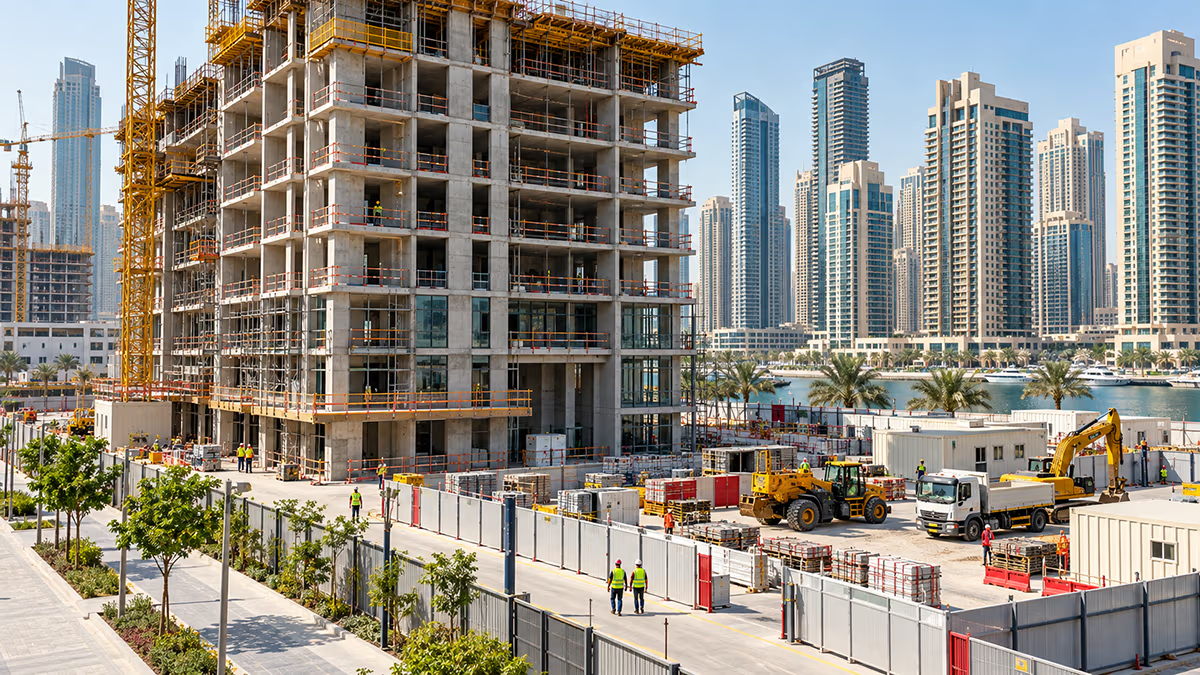
Construction stage. A project already well advanced carries less timing risk, and many of today's projects are in that position. Check the registered completion percentage on the Dubai Land Department website before each large payment.
"Before a client from Bulgaria committed to one- and two-bedroom units in Bay Grove, we mapped what was being built around the project, how new roads and services would change access, and what the downside scenarios looked like. A project is never judged on its own: the buildings and roads around it decide how easily you can rent or sell at handover."
Off-Plan Risk Checklist: Ten Things to Verify Before You Sign
Ten checks cover most of the risk in any off-plan purchase, and most of them are free and take minutes.
If you can tick eight or more, the project's risk is well understood and largely within your control. With six or seven, ask the developer or your adviser about the missing points before you sign. Fewer than six suggests waiting for more information or choosing a project further along.
Taken together, the checks show why off-plan in Dubai is less of a gamble than it looks from the outside. The law protects the money, the records are public, and most of the pipeline is close to completion. What remains is judgement: choosing the developer, the project and the timing that fit your plan.
Five Things to Remember About Off-Plan Investment Risk in Dubai
- Most off-plan risks in Dubai can be checked in public records before you sign.
- Escrow and registration protect your payments, and the rules for a failed deal are set in law.
- The developer's finished buildings tell you more than its brochures.
- A project already well advanced carries less timing risk.
- Match the payment plan to your income, and keep a plan for exit.
FAQ
Is buying off-plan property in Dubai risky?
It carries risks, mainly delay, market changes by handover and developer quality, and each can be checked in advance. Payments are protected by escrow, and most homes under construction are already in the final stage.
How does RERA protect off-plan buyers in Dubai?
The Real Estate Regulatory Agency registers off-plan projects, approves their escrow accounts and records each sale in the interim register. Your payments can only be used to build the project you bought into.
What happens to my money if a developer fails to deliver?
If a project is not completed, the escrow agent must either see it finished or return depositors' money, and if the regulator cancels a project the developer must refund all purchaser payments under Dubai law.
How do I check a developer's track record in Dubai?
Look at the developer's completed projects and recent handovers on DXB Interact, visit finished buildings, and confirm the developer and project registration on the Dubai Land Department website or the Dubai REST app.