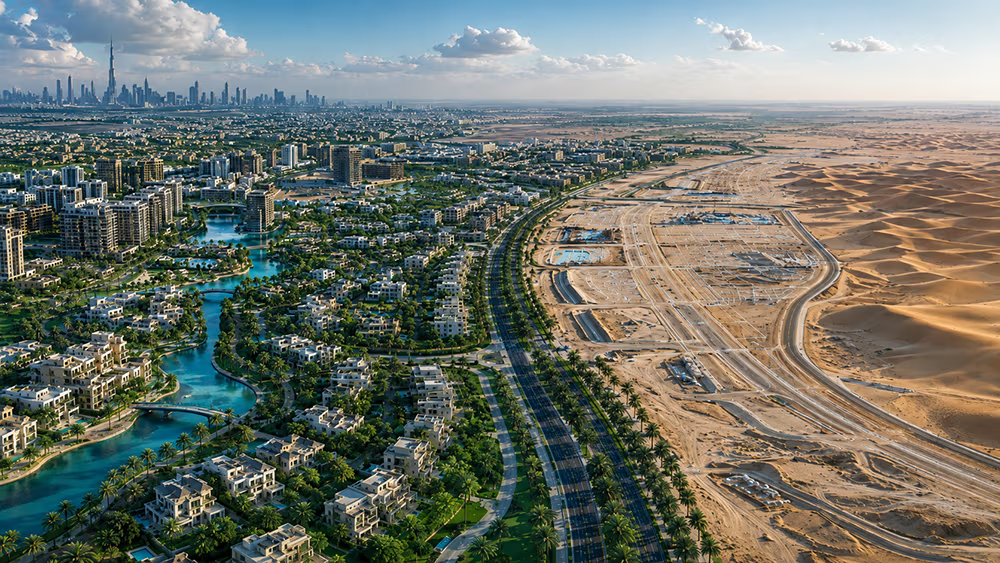
Why Invest in Dubai Real Estate in 2026?


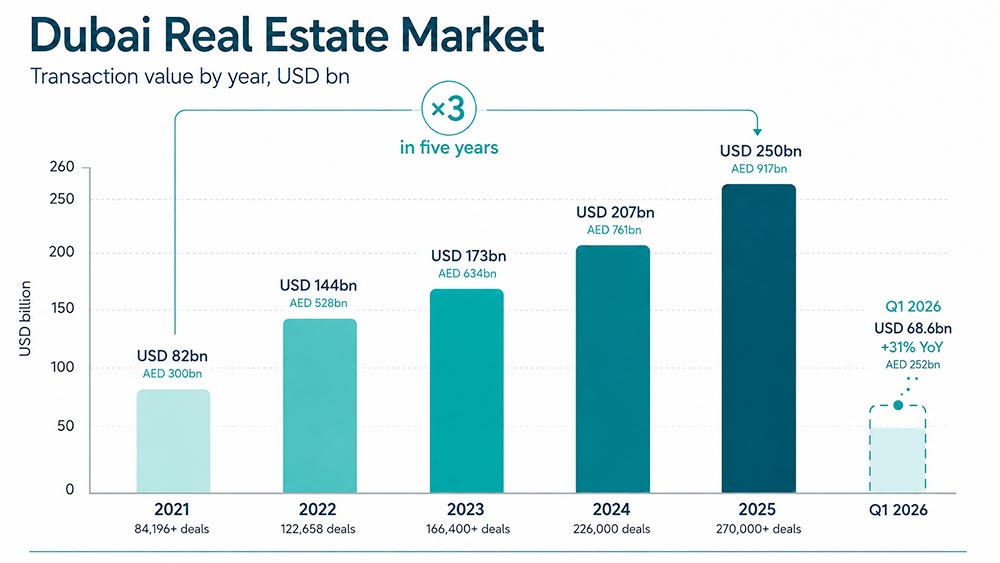
A one-bedroom flat in Dubai Marina earns more rent — tax-free — than a £500,000 London flat earns before tax. That is why capital keeps arriving: in 2025 Dubai logged 270,000+ real estate transactions worth USD 249.7 billion across the market, up 20% on the year.
But the easy 20–30% gains are over, supply is rising, and the wrong tower can quietly erase your yield. Here is the real case — returns, protections and risks — before you buy.
Is Dubai Real Estate a Good Investment?
For income and liquidity — yes, the numbers hold up: Dubai is one of the world’s most active property markets in 2026, deep enough that a well-priced unit sells within weeks. That depth is what protects an investor’s exit.
In 2025 the emirate registered 270,000+ transactions worth USD 249.7 billion, up 20% on 2024, and the pace carried into 2026 with USD 68.6 billion in Q1 alone, up 31% year on year (Dubai Land Department).
The buyer base is widening: around 193,000 registered investors in 2025 (+24%), of whom 129,600 were new to the market.
What makes that liquidity unusual is who is buying. Knight Frank estimates roughly 86% of Dubai transaction volumes in Q1–Q3 2025 were paid in cash, with no mortgage attached — so the market does not seize up when interest rates move, the way mortgage-dependent London or New York can.
Dubai property market in numbers in 2026
"Liquidity varies, though. Well-priced one- and two-bedroom apartments in high-demand communities typically draw offers within weeks, and A-grade resale stock changes hands in 30–60 days. Weaker or overpriced units can sit for 90 days or more — around 18% of luxury listings are cut within their first 60 days — and villas run a longer 60–120 day cycle. Volume is a market-level fact, so your exit still depends on the specific unit you own."
What Is Dubai Building by 2040?
Dubai is building for a resident population of 5.8 million by 2040 — 7.8 million counting its daily commuters and visitors — and much of the infrastructure to get there is already under construction.
The Dubai 2040 Urban Master Plan sets the frame: the resident population rising from about 4.0 million today toward 5.8 million by 2040 (7.8 million counting the daytime population), organised around five urban centres (including Dubai Silicon Oasis) and double the green and leisure space.
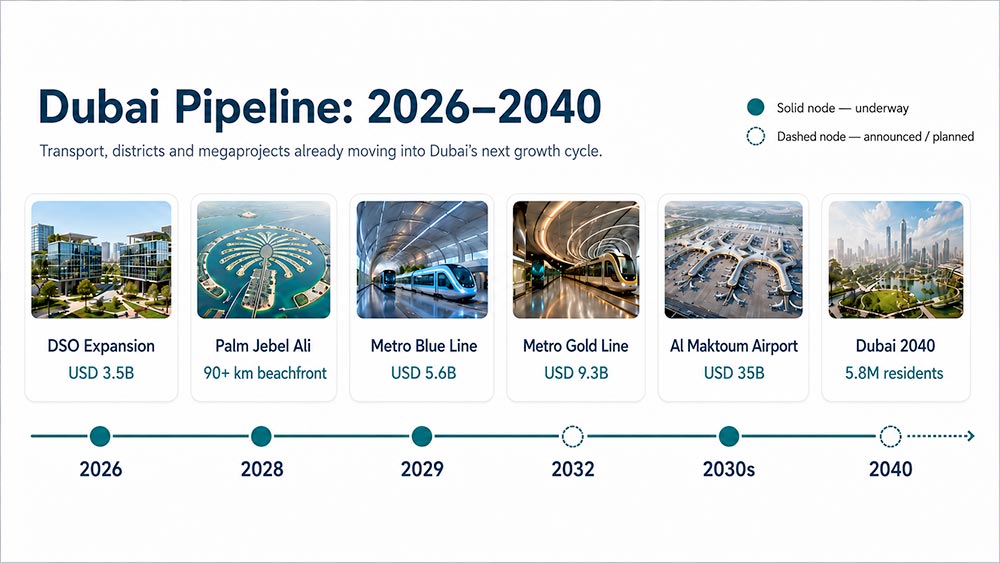
Under the D33 agenda, the city aims to double the size of its economy by 2033. That is the demand engine behind the property market — more people, more jobs, and more of the city they need built around them. The pipeline is concrete and dated:
For an investor, infrastructure is the clearest read on future demand — and the Red Line already proved it.
Since it opened in 2009, homes within a 15-minute walk of a station gained 26.7% in price per square foot, and those a 10–15 minute walk out gained 43.8%, against 24.1% for the wider market over 2010–2022 (CBRE Dubai Metro Report 2023).
Rents proved even more resilient: metro-proximate homes rose 5.7% between 2018 and 2022 while Dubai’s average rents fell 4.1%.
That is why the Blue Line matters now. It runs through Dubai Silicon Oasis, Academic City and Dubai Creek Harbour — the same corridors we cover in our Dubai Silicon Oasis and Dubai Creek Harbour guides — where a confirmed 2029 station is the catalyst still being priced in.
How much of this actually gets built?
Enough to take the plan seriously. Over the past two decades Dubai delivered the Palm Jumeirah (homes handed over from 2006), the Burj Khalifa and Downtown (2010), the Metro Red and Green Lines (2009 and 2011), the Dubai Water Canal (2016), Expo 2020 and its legacy district Expo City, and the Museum of the Future (2022). The city has a long record of finishing what it announces.
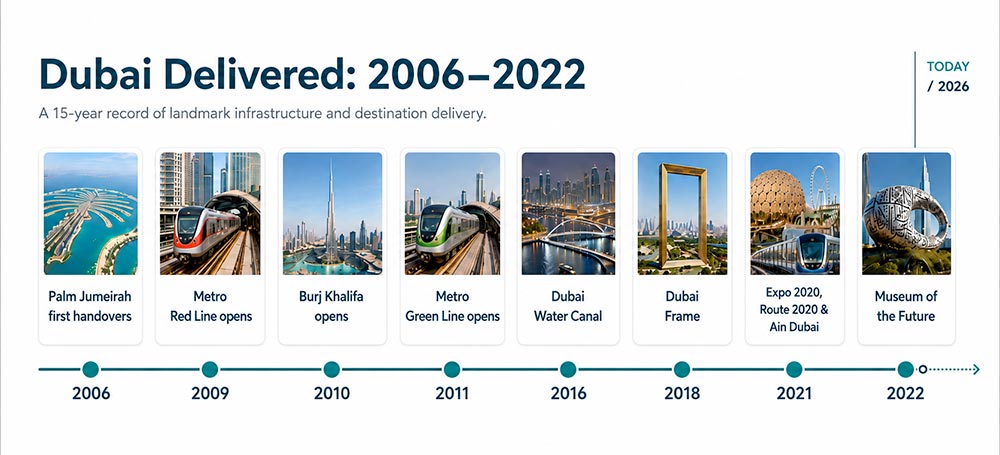
The limit is timing. Dates can slip — Expo 2020 and the Route 2020 metro extension were pushed back by the pandemic — so a line that is only announced is still just a promise.
What is bankable is what is being built now: the Blue Line — its AED 20.5 billion construction contract awarded in December 2024 — is expected to reach 30% completion by the end of 2026, while the Gold Line is approved but pre-construction: tender in 2026, contract award in 2027.
"We only price in infrastructure once it is under construction. The Blue Line is tunnelling today, so a unit near a confirmed 2029 station — in DSO, Academic City or Creek Harbour — has a real catalyst. An ‘announced’ line five years out is still just a promise."
Is Dubai Property Tax-Free?
Yes — for every tax that matters to a landlord: no income tax on rent, no capital gains tax when you sell, no annual property tax. The investor keeps effectively all of the rental income and all of the gain.
The UAE levies no personal income tax and no capital gains tax on individuals, and Dubai has no annual property (“council”) tax. The only transaction tax is a one-off 4% transfer fee paid to the Dubai Land Department at purchase.
On VAT: most residential leases and secondary residential sales are exempt, the first supply of a new residential building may be zero-rated, and commercial property is generally subject to 5% (UAE Ministry of Finance; Federal Tax Authority).
Dubai residential property taxes at a glance (2026)
What that adds up to is clearest against the markets investors actually compare. Take a USD 500,000 home, held ten years and sold for USD 700,000 — a USD 200,000 gain — and count the tax in each.
The 10-year tax bill: Dubai vs Spain, Miami and Australia
(USD 500,000 home, sold at USD 700,000)
"Buyers fixate on the 4% at the front. The costs that decide the outcome come later — every year you hold, and again when you sell: in Spain or the UK, the exit alone takes 19–24% of the gain. In Dubai, that line reads zero."
The UAE’s 9% corporate tax from 2023 targets business profits: an individual who owns a flat in their own name sits outside it, though it can apply to property held through a company.
And with no inheritance tax, an estate still follows UAE law by default — a non-Muslim owner who wants their own wishes to apply should register a DIFC will — a will for non-Muslims registered through the DIFC Courts Wills Service.
Dubai’s zero-tax status also does not override your home country’s rules: if you are tax-resident somewhere that taxes worldwide income or gains, you may still owe tax at home. We break the full cost stack down in our How to Buy Property in Dubai guide.
What Rental Yield Can You Earn in Dubai?
Dubai apartments yield about 7% gross in 2026 and villas about 5% — close to double what London returns. The figure that reaches your account, though, is net — what remains after the building’s charges and the empty weeks between tenants take their share.
Gross yield is the headline every listing shows; net yield is what an investor actually banks. Across the city, apartments average roughly 7% gross and villas about 5% in 2026, with the strongest gross figures in affordable communities and the lowest in prime addresses.
What’s a Good Net Yield in Dubai?
A good net yield on a well-selected Dubai apartment is about 5–6% — what remains after service charges, vacancy and management come out of the headline rent. A conservative citywide assumption is closer to 4–5%; the building decides which of the two you earn.
Here is the arithmetic on a USD 500,000 one-bedroom let at 7%
Service charges are the swing factor — roughly AED 10–80 (USD 3–22) per sq ft depending on the building (DLD Service Charge Index / Mollak) — so the same rent can net very different returns; check the building’s actual Mollak record before underwriting net yield. And 7% is a mid-market figure: cheaper communities such as JVC and Dubai Silicon Oasis run higher, while prime Downtown sits lower, as the spread below shows.
Yields also vary widely by district, and the pattern is consistent: affordable and mid-market communities pay more income, while prime addresses trade yield for appreciation and liquidity.
One more variable decides the real return: leverage. These net yields assume a cash purchase.
A non-resident mortgage in 2026 runs about 4.8–6.2% and is capped at 50–60% LTV (loan-to-value — the share of the price a bank will lend), so at today’s rates borrowing barely lifts the income return — the mortgage rate sits close to the net yield — though it frees capital and amplifies both the upside and the downside on price.
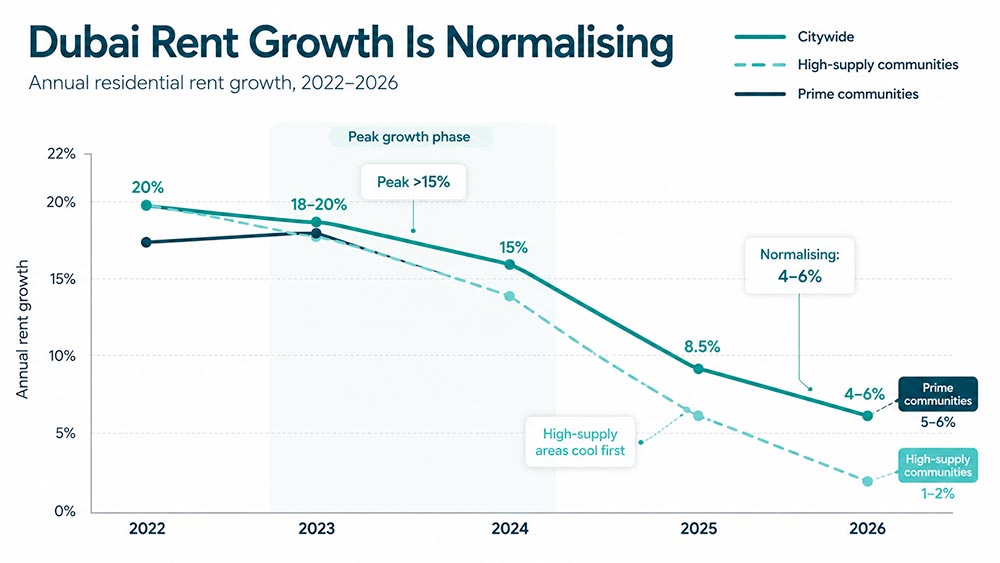
Rents themselves have cooled from an extraordinary run — citywide growth peaked above 15% in 2023–24 and has eased to roughly 4–6% in 2026 as new supply lands, with oversupplied communities softening first (RERA Smart Rental Index).
"Two towers on the same street, same rent — AED 12 against AED 30 per square foot in service charge — and one nets a full point of yield less than the other. I underwrite every deal on the net number, because that is the one that reaches the client’s account."
Will Dubai Property Prices Rise or Fall in 2026?
Both outcomes are plausible at once: citywide values may rise while oversupplied pockets correct — and the district decides which side you experience. ValuStrat expects citywide values up about 10% in 2026; Fitch warns of a correction of up to 15% in oversupplied mid-market segments — after prices climbed roughly 60% since 2022.
Dubai 2026 price forecasts: the two credible scenarios
Dubai property price cycles since 2008
The current data suggests the turn may be starting: Dubai’s residential sales index slipped about 1.8% month-on-month by April 2026 (apartments −1.9%, villas −1.1%), while staying roughly 6% higher year-on-year.
Market reporting through Q2 2026 shows the same pattern extending — softer momentum after the Q1 surge and more selective buyers. The long-term case survives it; the bar for building selection rises.
The pressure is real, and concentrated. Roughly 344,000 residential units are scheduled for delivery in 2026–2028 — ~77,500 in 2026, ~146,400 in 2027 and ~120,100 in 2028 (Cavendish Maxwell, Q1 2026) — with the largest clusters in Business Bay, JVC, Dubai South and MBR City, where rents and prices soften first.
Two facts cut the other way. Villas stay supply-constrained (hence the 17.7% villa forecast against 7.4% for apartments); and Dubai rarely delivers its pipeline in full: Knight Frank and Moody’s put the real materialisation rate — the share of announced homes actually delivered on schedule — near 46–48%. The headline supply figure overstates what actually lands.
Selection decides whether an investor lands in the +10% or the −15%.
How Does Dubai Property Compare to London?
A well-selected Dubai apartment nets about 5–6% a year after costs (4–5% is the conservative citywide assumption); the same capital in a London flat nets roughly 2.5–3.5% — and the UK taxes every stage of ownership, while Dubai taxes only the purchase, at 4%.
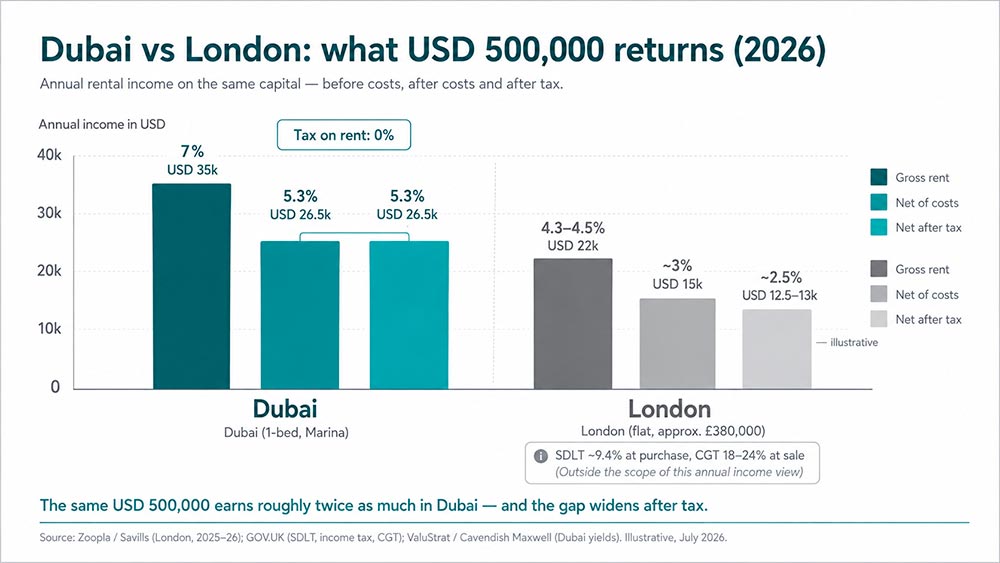
The opening line of this guide made a specific claim, so here is the arithmetic behind it.
London’s average gross yield runs at about 4.3–4.5% (Zoopla / Savills, 2025–26 — Mint data inputs), so a £500,000 flat collects roughly £21,500–22,500 a year — about USD 28,500–29,700 — before tax takes its share.
A one-bedroom in Dubai Marina at ~USD 450,000 lets at ~7% gross, or about USD 31,500 — tax-free, earned from roughly a third less capital.
The gap widens at every stage a UK investor is taxed. Take the same USD 500,000, placed in each city by a non-resident buyer:
London still buys things Dubai cannot. Title law tested over centuries, Europe’s deepest prime resale market, and rental demand that has survived every cycle since records began — that is what the yield discount pays for. Dubai offers the higher income precisely because the market is younger and cycles harder, as the price-cycle table above shows.
Currency cuts both ways too: the dirham’s dollar peg spares a dollar-thinking investor any FX risk, while a sterling-based buyer holding London property carries none at home. For income, the arithmetic favours Dubai roughly two to one; for a century of precedent, London remains the benchmark — and charges accordingly.
Is It Safe to Invest in Dubai Real Estate?
Yes — structurally so: title sits in a government registry, off-plan money sits in a legally mandated escrow account the developer cannot freely touch, and the dirham has been pegged to the US dollar at 3.6725 since 1997.
Safety in property has a precise meaning — can you lose the asset, the money you paid, or the value of the currency it is priced in? Dubai answers each with a specific mechanism, in a legal framework built out since 2007 and stress-tested by the 2008 crash:
- Title is a state record. Every completed property is registered with the Dubai Land Department; ownership can be verified in minutes through the DLD’s Dubai REST app, and no sale completes outside the registry.
- Off-plan money is ring-fenced. Under Escrow Law No. 8 of 2007, every off-plan project runs a dedicated RERA-approved escrow account. The developer draws funds only after independent engineers certify construction milestones — and 5% of project funds stay retained for a year after completion as a defects guarantee (Article 14).
- Off-plan purchases are registered too. Under Law No. 13 of 2008, each off-plan sale must be recorded in the DLD’s interim registry (Oqood) — so the buyer’s claim on the unit exists in the government system before the tower does.
- Developer failure has a script. If a project is officially cancelled, a RERA-appointed auditor distributes the escrow balance back to buyers within 14 days, and a special judicial tribunal formed under Decree No. 33 of 2020 pursues developers for any shortfall — the machinery Dubai built to clean up its stalled post-2008 projects.
- Defects are the builder’s problem, twice over. A contractual defects liability period (typically one year from handover) covers snags and systems; UAE law holds contractor and engineer jointly liable for ten years for structural failure — a regime retained in Articles 821–824 of the new Civil Transactions Law (Federal Decree-Law No. 25 of 2025, in force since 1 June 2026), and one the parties cannot contract out of.
- Listings and brokers are licensed. Every advert requires a Trakheesi permit number, and every broker a RERA licence (BRN) — both checkable before you respond to an offer.
How the system reads from outside: JLL’s Global Real Estate Transparency Index 2024 ranks Dubai 28th of 89 markets — the only market in MENA rated “Transparent” — and among the top improvers worldwide since 2022, credited for its registry data and anti-money-laundering rules.
Currency risk gets a structural answer as well. The dirham has held at AED 3.6725 to the US dollar since 1997 (Central Bank of the UAE), so an investor who thinks in dollars holds a Dubai asset with no FX layer between the rent and their base currency — a contrast with London (GBP), Istanbul (TRY) or Bangkok (THB).
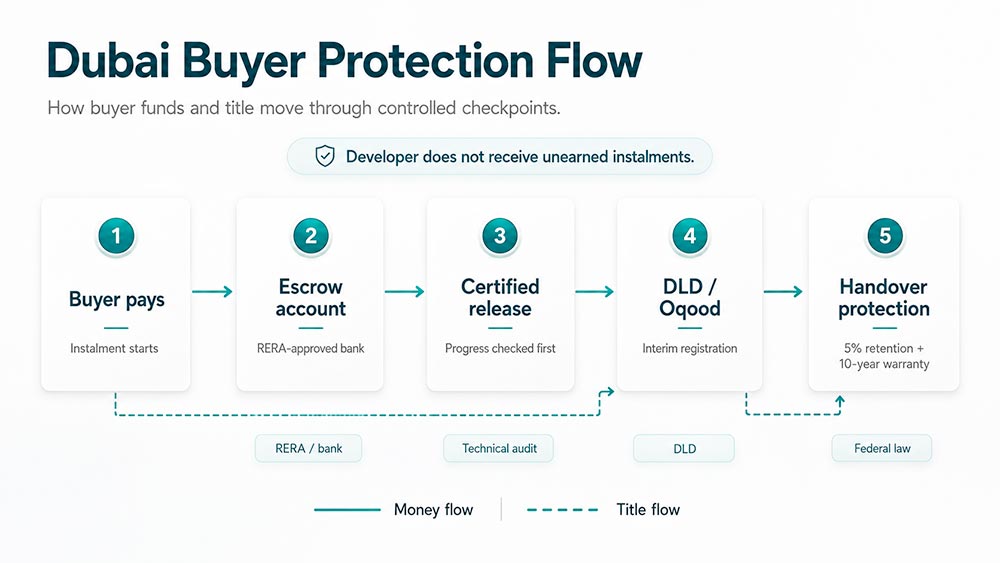
The limits deserve equal billing. Escrow protects the money, and the registry protects the ownership — nothing protects the calendar or the price. Off-plan projects do run late (recall that only about half the announced pipeline materialises on schedule), and a buyer whose tower is delayed two years has their capital safe in escrow yet earning nothing.
Fraud has also moved to the edges of the system. The classic losses today involve unlicensed intermediaries, deals done on reservation forms outside Oqood, or transfers to personal accounts — all avoidable, none recoverable.
And no registry insures against the market itself; the Fitch scenario from the forecast section applies to protected and unprotected buyers alike.
Before any money moves, four checks close most of that residual risk — each takes minutes:
- The project’s escrow account details (IBAN) — from the DLD; pay into it, never a personal or company account.
- The Trakheesi permit number on the listing you responded to.
- The broker’s RERA card (BRN) — verifiable in the Dubai REST app.
- The Oqood registration of your sale, confirmed promptly after signing.
The full document-by-document sequence is in our How to Buy Property in Dubai guide.
Can Foreigners Buy Property in Dubai?
Yes — any nationality can own Dubai property outright, in perpetuity, in the city’s designated freehold zones. No residency, local partner or special permission is required, and the title is the same DLD record a UAE citizen holds.
Law No. 7 of 2006 (Article 4) opens property ownership to non-UAE nationals in designated areas, and Regulation No. 3 of 2006 lists those areas — dozens of designated zones that include almost every district an international investor has heard of: Dubai Marina, Downtown, Business Bay, JVC, Dubai Silicon Oasis, Dubai South, Palm Jumeirah.
Freehold here means full ownership of the unit plus a proportionate share of the land, with no time limit; outside the designated zones, ownership stays reserved for UAE and GCC nationals.
Dubai freehold zones at a glance in 2026
The purchase itself can be completed remotely under a power of attorney — most buyers fly in for the deal, but the law does not require it.
The practical variable is banking, and it depends on the buyer’s passport: transfer rails, source-of-funds checks and KYC (the bank’s identity and origin-of-money checks) differ by citizenship and by where the money sits, so we map that route before any deal is agreed — the banking specifics are covered in the How to Buy guide.
How Much Do You Need to Invest in Dubai Property?
A realistic entry ticket is about USD 120,000–150,000 for a studio in a budget freehold district, and from ~USD 190,000 for a one-bedroom in a high-yield community like DSO or JVC — plus roughly 7% on top for transaction costs.
The cleanest way to see the market’s spread is price per square foot, taken from registered transactions — asking prices flatter the seller — and the Dubai Land Department’s open transaction records log every sale, which is what the figures below rest on.
In 2026, apartment deals start from about USD 190 per sq ft in International City and from ~USD 955 on Palm Jumeirah — a five-fold ladder inside one city, with the freehold title identical on every rung:
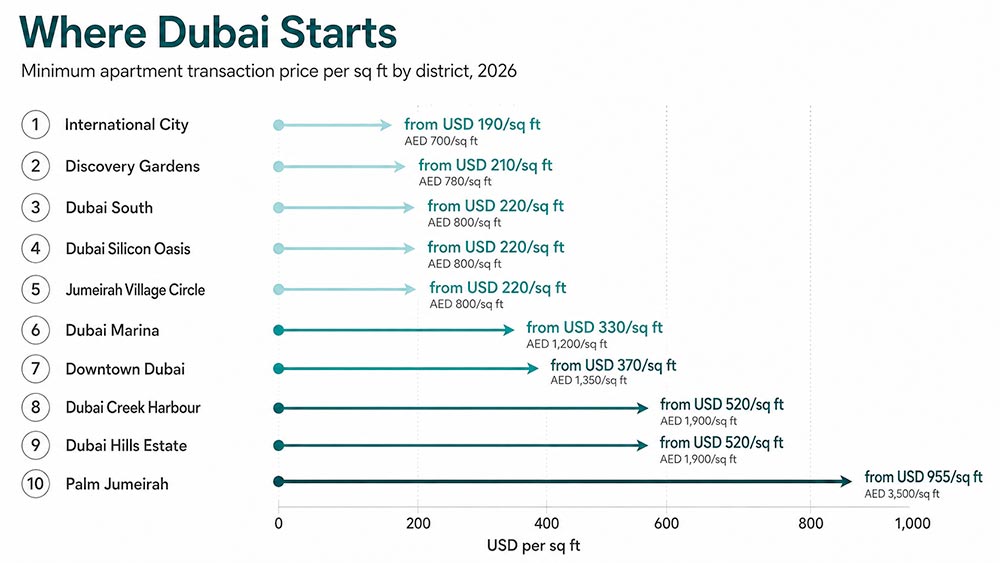
Two readings of the ladder. At entry prices from ~USD 245 per sq ft in Dubai Silicon Oasis, a 500 sq ft studio prices near USD 120,000–150,000 — which is why the highest rental yields in the city sit on the ladder’s lower rungs, as the district table earlier showed. And an entry figure is exactly that: district averages run far higher (Business Bay’s transacted average, for instance, is pulled up by new branded towers while its entry resale stock trades from ~USD 350,000 for a one-bedroom — the market our yield table describes).
Whatever the rung, the entry budget carries the same additions: the 4% DLD transfer fee, ~2% agency commission and fixed trustee/registration charges — budget about 7% on top of the price.
Off-plan payment plans lower the initial cash outlay (typically 10–20% at booking, the rest staged to handover under the escrow rules covered in the safety section), which is the lowest-capital route in.
Financing is available as well: non-resident mortgages run at 50–60% LTV on the rates covered in the yield section, though most foreign buyers in Dubai complete in cash — Knight Frank put the cash share near 86% in 2025, as noted at the top of this guide.
Does Buying Property in Dubai Give You a Visa?
Yes — ownership of any completed Dubai home now qualifies a sole owner for a renewable 2-year residency visa, with no minimum value since April 2026; property worth AED 2 million (~USD 545,000) qualifies for the 10-year Golden Visa.
The April 2026 change is recent enough that most guides online still quote the old AED 750,000 (USD 204,000) floor — Dubai abolished it for sole registered owners of completed residential property; joint owners each need a stake of at least AED 400,000 (USD 109,000).
The Golden Visa track eased earlier the same year: a federal circular removed the AED 1 million upfront-payment requirement, so eligibility now follows the total value recorded in the title deed or Oqood, without a paid-up threshold — for joint ownership, the applicant’s own share must still reach AED 2 million (GDRFA). Applications for property owners run through the DLD’s Golden Visa service.
Across the purchases we structure, one route is underused: joint ownership.
Since April 2026, a couple registering an AED 800,000 (~USD 218,000) apartment in equal shares — AED 400,000 each — qualifies both owners for the 2-year residency visa from a single property — under the old AED 750,000 floor, the same couple needed roughly twice the capital for the same two visas.
Dubai property visas: 2-year investor visa vs 10-year Golden Visa in 2026
The visa follows the asset, so selling the property ends the basis for renewal. A residency visa grants the right to live in the UAE — citizenship is a separate track entirely. And holding one does not by itself change where you owe tax: tax residency has its own day-count and centre-of-life tests. The application mechanics sit in our How to Buy Property in Dubai guide.
Should You Invest in Dubai? Risks and Verdict
Yes — if the goal is ~5–6% net rental income on a well-selected unit, with structural capital protection and a holding horizon of 3+ years. No — if the plan needs guaranteed appreciation, or the money may be needed back within two years.
“Should you invest in Dubai” has no citywide answer, because the citywide numbers no longer decide the outcome — the specific building and the buyer’s own profile do. This closing section makes the case against Dubai first, then gives the scorecard we use with clients.
What Are the Risks of Buying Property in Dubai?
Five risks are real enough to price in: oversupply, exit liquidity, off-plan delay, an economy geared to global flows, and the currency-and-tax position of a foreign holder.
Every figure below has appeared earlier in this guide with its source; here they stand together as a buyer’s checklist.
Dubai property risks and counterweights as for 2026
The five rows carry one lesson between them: none of these risks is hedged by the city’s averages — every one is hedged by selection.
A tower outside the oversupply zones, priced to the district’s transacted level, by a developer whose delivery record is public in the DLD registry, removes most of the table above. That is also why the credible forecast is a fan, and both edges of it hold at once:

Who Should Invest in Dubai — and Who Shouldn’t?
Dubai in 2026 fits an income-and-preservation investor with USD 150,000+, a 3-year-plus horizon and tolerance for a paper drawdown. It does not fit anyone who needs guaranteed growth or quick re-access to the cash.
Locate yourself in the scorecard — it is the same one we run in client reviews:
Three or more answers in a column is your verdict.
A Buy profile should still buy slowly: transacted prices over asking, net yield over gross, and infrastructure already under construction over announcements.
A Wait profile loses little by waiting — the 2026–28 supply wave lands mostly in four districts, and watching two quarters of the DLD price index costs nothing.
A Pass profile should hear it plainly: there are better instruments for guaranteed returns, and Dubai property is not one of them.
And whom do we turn away? Anyone shopping for the 20–30% annual gains of 2021–23 — that market delivered +75% in three years and is finished, as the −1.8% April 2026 index print shows; anyone investing money they cannot leave in place for three years; and anyone who wants the decision made for them.
The scorecard shortens the conversation, but it never replaces underwriting the specific building.
"The most useful thing I do for clients is talk a share of them out of buying. If someone needs a guaranteed 20–30% a year, I say plainly: that market ended in 2023 and I cannot underwrite it. What Dubai still pays, reliably, is 5–6% net on the right building, with the capital protected by a registry and an escrow — and I will defend every number in that sentence."
Five Key Takeaways
- The tax gap compounds at the exit, where buyers least expect it. On a USD 500,000 home sold at USD 700,000 after ten years, the taxes total ~USD 20,000 in Dubai against ~USD 120,000–180,000 in Spain, Miami or Australia — most of the difference lands in the years you hold and the day you sell.
- Net decides everything; gross is marketing. Service charges span roughly AED 10–80 (USD 3–22) per sq ft (DLD Mollak), so two towers on one street with identical rents can differ by a full point of yield. Check the building’s own numbers before the district’s.
- The 344,000-unit supply wave is real — and roughly half of it will be late. Historical materialisation runs at ~46–48% (Knight Frank / Moody’s) and the wave concentrates in four districts. That is how ValuStrat’s +10% and Fitch’s −15% are both credible for 2026.
- Only under-construction infrastructure is investable. Homes near the Red Line outgained the market by up to 20 points after 2010 (CBRE); the Blue Line is tunnelling toward 2029 — while an “announced” line is still just a promise.
- Since April 2026, the visa maths changed and most guides haven’t noticed. Any completed home qualifies its sole owner for a 2-year residency visa — no minimum value; joint owners qualify at AED 400,000 each; the Golden Visa stays at AED 2M (~USD 545K).
FAQ